
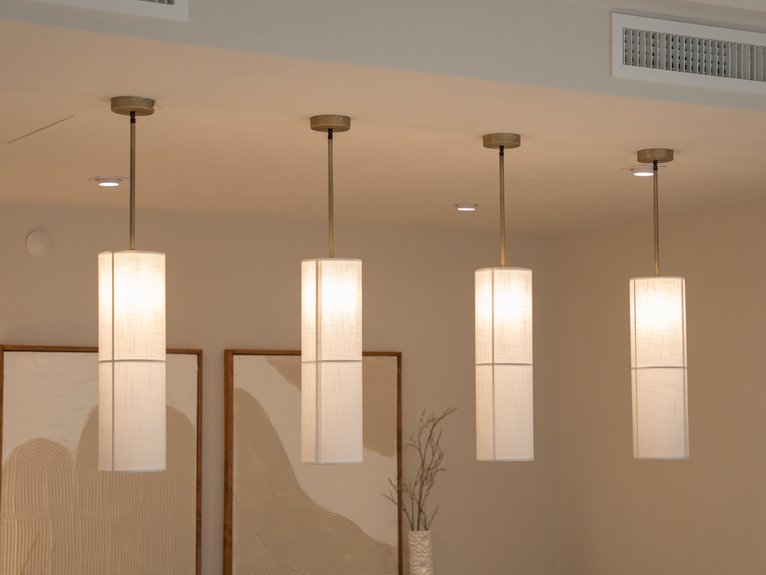
I’ll help you pick between these fixtures quickly. Pendants hang slim and focused, making them ideal for tight spaces and intimate table lighting, while chandeliers command attention with a broad, ambient glow in larger rooms. You’ll need 8-foot ceilings for pendants, whereas chandeliers require 9 to 10 feet. Costs range from $50 for pendants to over $1,400 for chandeliers, and installation can be more complex for heavier chandeliers. Light quality, maintenance costs, and safety specifications differ as well. Stick around, and I will break down which option fits your space.
Chandelier vs Pendant: Which Fits Your Restaurant?
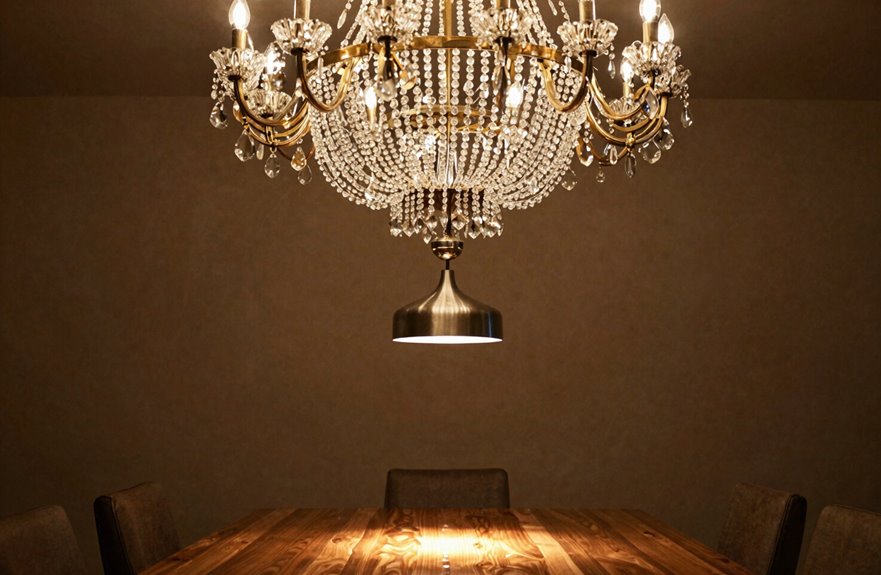
Choosing between chandeliers and pendants for my restaurant starts with defining the desired atmosphere. In larger or high-ceiling spaces, a chandelier serves as a commanding centerpiece that draws guests together. For a more intimate setting, pendants work well, hanging 24 to 28 inches above tables to create focused pools of light that encourage conversation. They fit comfortably in 8-foot ceilings, allowing for cozy corners that welcome guests. In a casual space, mixed pendants clustered over counters create a sense of community at each table. On the other hand, a fine dining room benefits from a chandelier’s grandeur, with pendants added alongside for layered sophistication. Together, these choices help create inviting environments for all.
How Each Fixture Spreads Light Differently
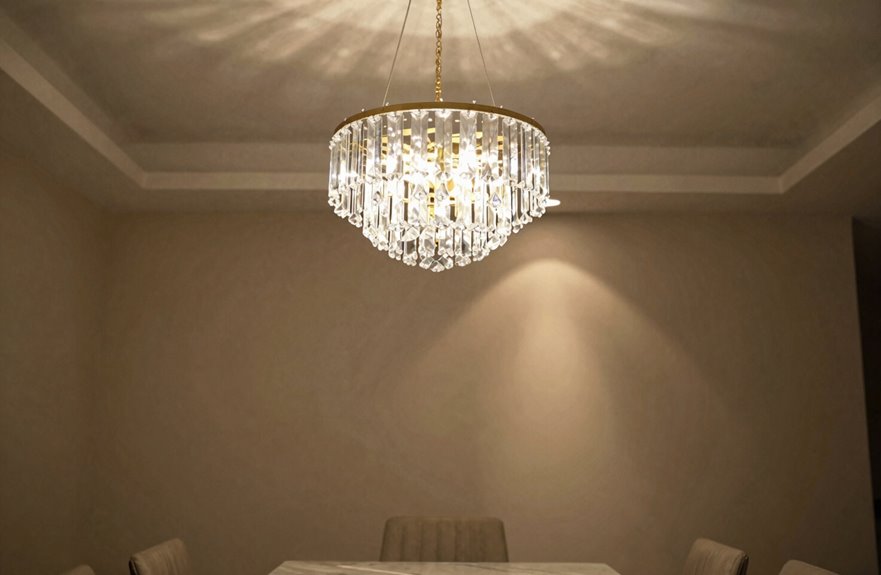
I examine how pendants and chandeliers influence beam spread patterns, layering potential, and shadow dynamics to understand their practical effects. Pendants emit tight, focused beams that allow for layered lighting in a room, while chandeliers provide broad, even illumination from a central point. I observe that pendants create straightforward and predictable shadows beneath each fixture, whereas chandeliers produce more complex patterns due to their arms and decorative elements.
Beam Spread Patterns
How does light travel once it leaves the fixture? Beam spread significantly influences our experience of spaces.
Pendants deliver a tight, focused beam spread that pools light where we need it—over dining tables, kitchen islands, or home bars. Clustering them allows for tailored coverage, creating intimate zones that encourage gathering.
Chandeliers, with their multiple arms, spread light broadly, washing entire rooms with ambient glow. They cast gentle, dancing shadows from their decorative frameworks, though ornate designs can create complex patterns that require balancing.
Pendants provide high-contrast, directional lighting ideal for tasks and conversations. Chandeliers, on the other hand, offer an even, welcoming fill that enhances shared moments. Both dim beautifully, yet their beam spread fundamentally shapes where we gather.
Layering Potential
When designing a room’s lighting scheme, I focus on how fixtures work together rather than in isolation; this is where pendants and chandeliers showcase their unique characteristics. Pendants create targeted layers through focused, directional pools, especially when grouped over tables or work surfaces. This allows for precise task illumination in specific areas. I appreciate how clusters of pendants enable the creation of intentional brightness zones that feel personal and purposeful.
Chandeliers, on the other hand, establish foundational ambient layers with their larger vertical footprint and multiple bulbs. They evenly fill spaces, minimizing harsh gaps between light sources. In dining areas, I often combine both: pendants provide intimate, directed light over the table, while a chandelier envelops the surrounding space in inviting fill light. Together, they add depth that enhances the overall atmosphere.
Shadow Dynamics
Why does shadow matter so much in lighting design? Shadow dynamics shape our emotional experience in a space, influencing whether we feel cozy and included or exposed and alone.
Pendant lights draw us together through their focused beams, pooling light precisely where we gather and casting crisp, defined shadows beneath each fixture. When clustered, overlapping light and dark gaps create rhythm across our tables.
Chandeliers provide broader, more welcoming ambient light. Their multiple bulbs diffuse shadows evenly, while ornate crystals and metalwork scatter intricate patterns across walls, resembling shared secrets dancing overhead.
We can control these shadow dynamics with dimmers. Dimming pendants tightens shadows for intimate tasks, while dimming chandeliers softens everything into a unified, comforting glow. Choose shadows that envelop your guests in a sense of belonging.
Ceiling Height Needs: Chandeliers vs Pendants
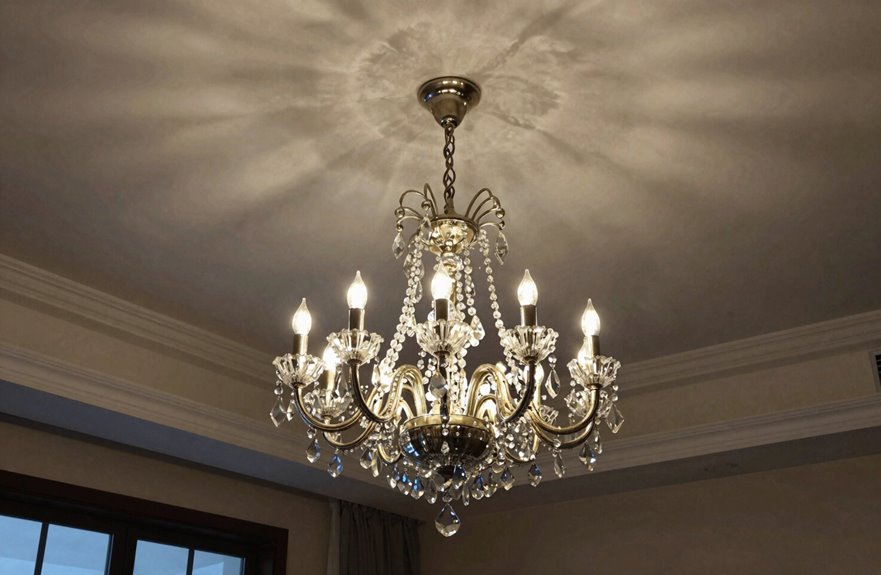
Where should your ceiling height be before deciding on a chandelier or pendant? Measuring ceiling height is essential as it influences your choices. Pendants work well under 8-foot ceilings due to their slim profile, while chandeliers require more space, ideally 9 to 10 feet, to maintain proper proportion.
Consider the vertical footprint: chandeliers can span 18 to 36 inches plus hardware, which means headroom can diminish quickly. Both types of fixtures need 7 feet of clearance above floors where people walk. If your ceiling height is borderline, semi-flush chandeliers or drum-shade pendants are good options that save space without sacrificing style. This approach ensures lighting enhances the ambiance of your home rather than creating obstacles. Matching your ceiling height to the right fixture makes your space feel intentional and inviting.
Chandelier vs Pendant: Upfront Costs Compared
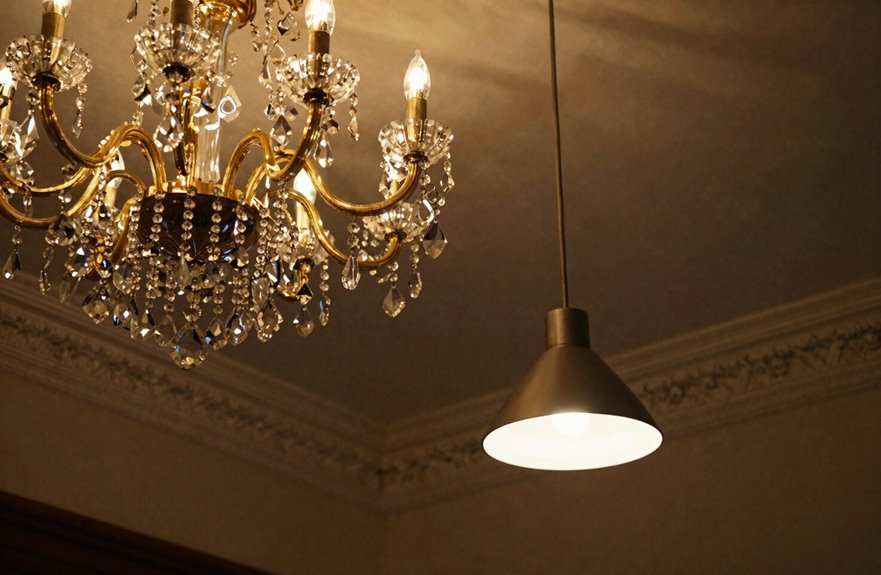
Ceiling height shapes your options, while your budget often influences the decision. If you’re seeking lighting that welcomes everyone in, pendants are a cost-effective choice. A single pendant costs between $50 and $250, whereas chandeliers start around $120 and can exceed $1,400. This price difference is significant when furnishing multiple spaces or creating a cohesive design throughout your home.
Pendants provide predictable spending. Their narrower price ranges lead to fewer unexpected expenses, and when your project requires several fixtures, pendants enhance your savings. Dining areas can look stunning with clustered pendants instead of one large chandelier, offering the same warmth at a more manageable cost.
Chandeliers require a larger financial commitment, especially for standout pieces. For gatherings where a welcoming atmosphere is essential, pendants offer inviting light without the steep price tag.
Installation Surprises and Extra Fees
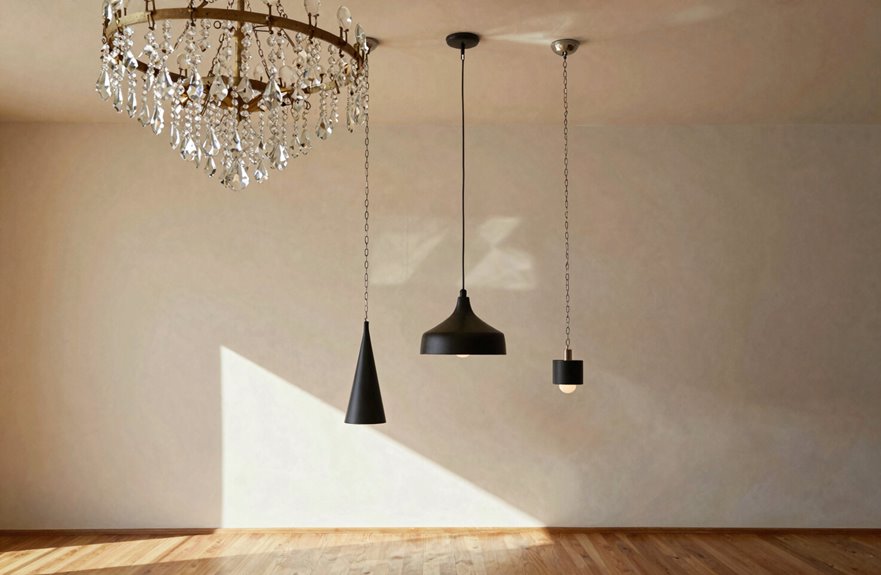
How much will installation really set you back? Installation costs quickly separate pendants from chandeliers. Pendants typically run $100–$300 per fixture, while chandeliers demand $150–$1,500 each. That gap reflects mounting complexity. Heavier chandeliers need reinforced ceiling boxes or structural support, driving up material and labor time.
Ceiling height can surprise homeowners. Chandeliers generally require 9–10 ft ceilings with 7 ft floor clearance, making planning difficult in tighter spaces. Wiring dimmable LEDs and compatible controls adds unexpected charges for either fixture type. Multipoint setups, such as clustered pendants or swag chandeliers, complicate routing and require extra conduit, junction boxes, or ceiling modifications. These installation realities influence which fixture fits your space and budget.
Lumens Needed for Restaurant Dining Rooms
I start restaurant lighting plans with 30–40 lumens per square foot as my baseline, then sharpen that focus where it counts. Tables require more precise illumination than walkways, so I position pendants or chandeliers to achieve those target levels without washing out plates. I layer ambient, task, and accent sources together since no single fixture type can effectively manage every dining moment on its own.
General Lumen Guidelines
When planning lighting for a restaurant dining room, it’s essential to start with lumens, specifically targeting 30–40 lumens per square foot for comfortable ambient brightness where guests linger over meals and conversation. Here’s what matters most:
- Size up your space: A 200–400 sq ft room needs roughly 6,000–16,000 lumens total.
- Consider your surfaces: Dark walls and low reflectance demand higher lumen counts.
- Plan for dimming: Starting brighter allows for mood adjustments throughout service.
- Choose quality LEDs: Aim for CRI 90+ and 2700K–3000K to enhance the appearance of food.
- Balance your layers: Blend ambient and task lighting to eliminate harsh shadows from statement fixtures.
Chandeliers spread lumens broadly, while pendants concentrate them. Both methods are effective; just ensure you calculate your totals before making a decision.
Table-Specific Requirements
Where should those lumens land once I’ve mapped my room’s totals? I aim for 30–40 lumens per square foot in my restaurant dining room, focusing on the tables where guests gather.
Pendant lights provide a concentrated pool of light right where diners sit. I position them low enough to create intimacy while minimizing glare. I multiply fixture output by my pendant count, then adjust for height and spread to ensure no one sits in shadow.
Here’s how I break down my table plan:
| Factor | My Target |
|---|---|
| Color temperature | 2700K–3000K |
| CRI rating | 90+ minimum |
| Pendant spacing | Even grid pattern |
| Lumen focus | Table surface, not ambient wash |
I choose LED sources that render food beautifully. Multiple pendant lights allow me to collaborate with fellow designers who prioritize precision.
Layered Lighting Approach
Why limit yourself to a single fixture type when using both pendants and chandeliers provides complete control? Layered lighting can transform restaurant dining rooms into inviting spaces where guests want to linger.
Most designers target 30–40 lumens per square foot; that serves as my starting point. Here’s how I foster a sense of belonging through light:
- Pendants create intimate zones where friends lean in to share stories over detailed menus.
- Chandeliers wrap the whole room in a welcoming ambient glow without harsh shadows.
- Dimmable LEDs allow for a smooth transition from a bustling lunch to a romantic dinner.
- CRI 90+ bulbs enhance food presentation, ensuring it looks irresistible.
- Warm 2700K–3000K tones make every table feel like the best seat in the house.
These fixtures work together harmoniously.
Pick by Restaurant Type: Fine Dining to Fast Casual
How do you choose between a chandelier and a pendant when every restaurant type demands something different? Fine dining spaces often require chandeliers to create true grandeur; nothing welcomes guests into your world quite like that statement moment. Layering a central chandelier with task pendants above each table creates an intimate, VIP glow for diners.
Chandeliers command grandeur; layered with pendants, they craft intimate, VIP moments for discerning guests.
For casual bistros, grouping varied pendants over bars and tables adds visual interest without dominating the scene. In fast casual spots, pendants provide flexibility; they can be reconfigured as menus and layouts shift.
In large dining rooms, anchoring the space with chandeliers as the focal point works well. Running perimeter pendants offers clean, functional light.
Wherever you land, ensure the fixture style matches your furniture and materials. It is important to avoid mixing 2700K with 4000K in one room.
Energy Use and Upkeep: Chandeliers vs Pendants
Once I’ve matched fixtures to my restaurant’s atmosphere, I need to consider the long-term costs. Energy use is significant; both fixtures work well with LEDs and achieve 75–80% savings. However, my actual bill depends on the total wattage across all bulbs. Here’s what my fellow restaurant owners and I evaluate:
- LED retrofits significantly reduce consumption for either fixture type.
- Chandeliers incur higher annual maintenance costs ($200–$600 vs $100–$300).
- Pendants are easy to clean; chandeliers require scaffolding and careful handling.
- Heavy chandeliers need structural support; pendant kits are easy to install.
- LEDs last 25,000–50,000 hours, although chandeliers have more failure points.
My decision will be based on my team’s capacity and my building’s infrastructure, not just aesthetics.
Fixture Trends: Oversized Pendants and Minimalist Chandeliers
What’s currently reshaping restaurant lighting design? Oversized pendants are dominating spaces, often scaling 24–40 inches or clustered for bold impact without crowding sightlines. A single statement pendant light commands attention where chandeliers once ruled.
Minimalist chandeliers also catch my eye, featuring clean lines, fewer arms, and finishes like matte black or brushed brass that convey subtle elegance. Low-profile LED modules in these fixtures provide significant brightness without adding visual bulk.
I pair these with neutral palettes and understated furnishings, allowing the lighting to function as architecture rather than mere decoration. Occasionally, I cluster smaller pendants to achieve a chandelier-like density while maintaining the modular flexibility I appreciate. The result feels curated and intentional, creating spaces that invite connection and comfort.
Safety Specs Restaurant Inspectors Check
I start every restaurant lighting install by confirming the mounting box can handle the chandelier’s weight, since inspectors will check that rating against NFPA 70 standards first. I also ensure every pendant and chandelier carries proper UL or ETL listing and pairs with compatible dimmable controls, as electrical code compliance is essential during inspections. These two requirements—mounting weight limits and full electrical code compliance—are crucial for keeping heavy ceiling fixtures safe, legal, and ready for daily restaurant use.
Mounting Weight Limits
How much weight can your ceiling actually handle? Ceiling load constraints are crucial, especially when inspectors arrive.
Chandeliers can tip 50–200+ pounds, so I am checking my mounting box rating before anything goes up. Pendants are lighter, usually under 20 pounds each, but I still need to distribute their load smartly.
Here are the steps I take to ensure compliance and safety in my space:
- Verifying my electrical box handles the exact fixture weight
- Using manufacturer-documented brackets and anchors only
- Adding bracing or reinforced joists when chandeliers demand it
- Calculating total fixture weight across the entire ceiling
- Confirming seismic and fire-rated hardware meets local code
Restaurant inspectors enforce these standards strictly. My ceiling’s strength depends on its weakest support point, and I ensure there are no weaknesses.
Electrical Code Compliance
Mounting weight limits are irrelevant if the electrical setup fails inspection.
Your restaurant lighting should feel welcoming, not worrisome. Electrical safety standards are crucial in this industry. I always verify that my chandeliers and pendants carry UL/ETL listings and meet NFPA 70 requirements for commercial spaces. Fixtures need proper ceiling boxes rated for their actual weight, plus wiring that complies with regional codes for gauge and overcurrent protection.
I do not take risks with damp locations; kitchens and outdoor-adjacent dining areas require a minimum IP44 rating against moisture and steam. I test dimmable circuits for consistent CRI 90+ performance at 2700K–3000K temperatures. I maintain seven-foot clearances and secure mounting to ensure safety. When inspectors visit, you will be among the professionals who prioritize compliance.
Your 30-Second Fixture Decision Checklist
Where do you need light, and what level of drama are you aiming for? Choosing between fixtures depends on your space and lifestyle.
Here’s a quick checklist:
- Measure your ceiling height; pendants work at 8 feet, while chandeliers require a minimum of 9–10 feet.
- Count your budget; pendants range from $50–$250 with simpler installations, while chandeliers start around $120 and increase quickly.
- Define your purpose; task lighting calls for pendants, while ambient glow is suited for chandeliers.
- Consider flexibility; group pendants for customization, or opt for one bold statement piece.
- Check your room scale; small nooks benefit from pendants, while grand entryways require chandeliers.
Select your fixture based on your needs to enhance your living space each time you turn on the light.