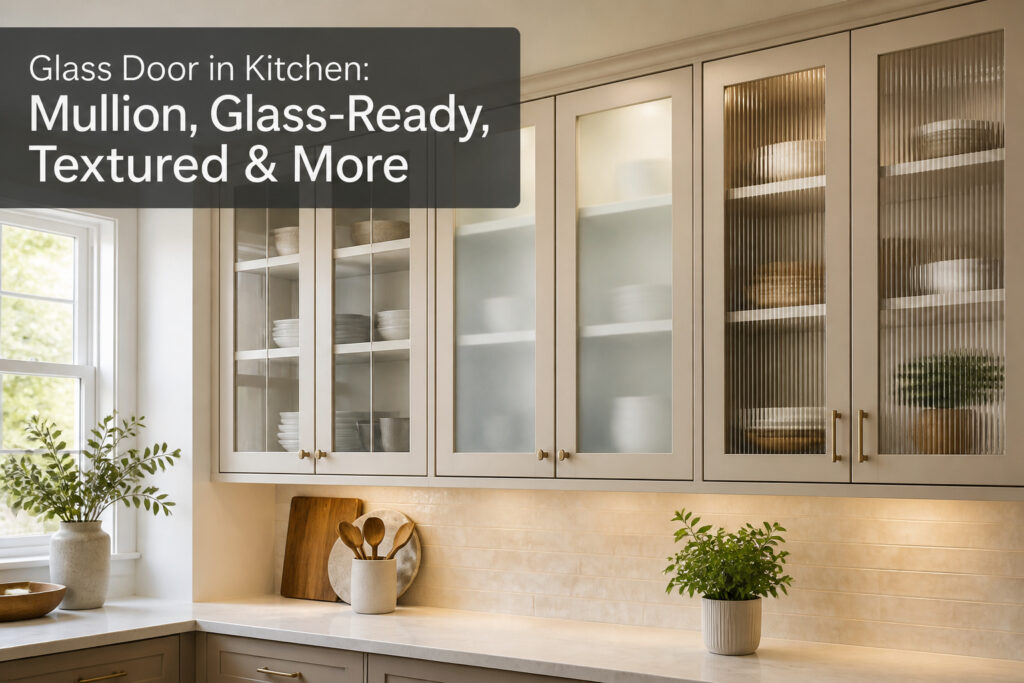
A glass door in kitchen cabinetry is a framed panel with a pane installed in place of solid wood, turning cabinet storage into a visible feature. The catch is that the glass you choose, and the way the frame is built to hold it, matters more than the door style itself. Most kitchen cabinet doors are slotted for a 1/8 inch pane, held by retainer clips or a silicone bead, and the same thickness fits mullion, glass-ready, and aluminum frames alike. That 1/8 inch specification is what lets you swap frost for reeded glass later without replacing the frame.
Mullion Glass Doors
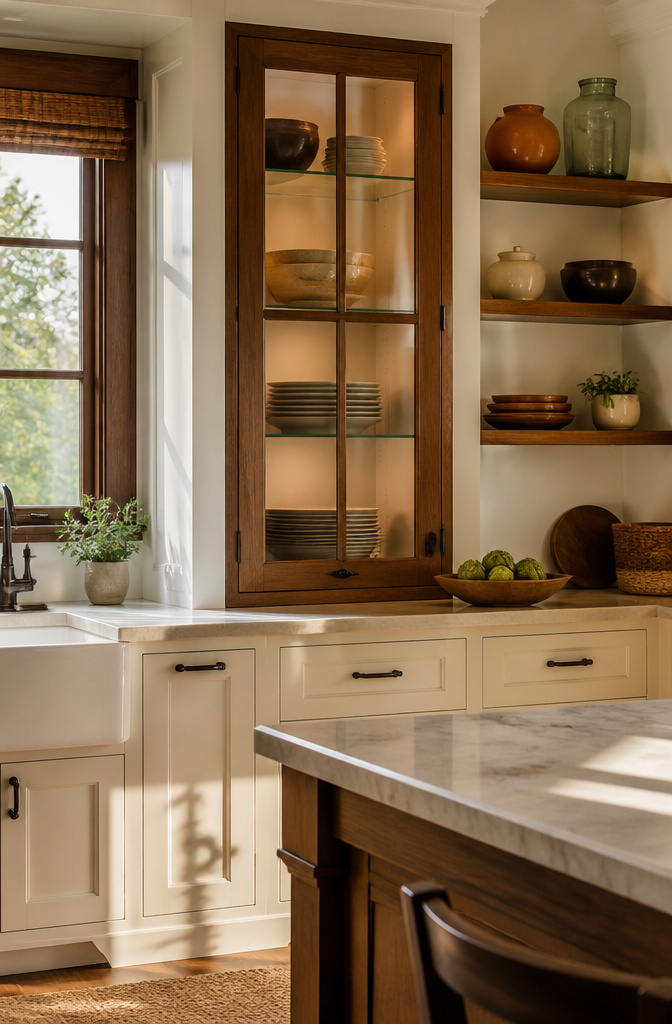
Mullion cabinet doors divide a single glass panel into smaller sections using solid wood grilles, a detail that reads as traditional craft rather than modern minimalism. The standard unfinished door sits at 3/4" thickness, with framing stiles and rails at 2 1/4" and the mullion bars themselves at 5/8" width. Configuration names are simple counts: 1-lite leaves the glass whole, 4-lite splits it into quadrants, and 6-lite adds a horizontal mid-rail for a taller grid. The back of each door is slotted for glass, and a retainer moulding holds a 1/8" pane without fuss. Paint-grade hard maple now comes white-primed if you want color, while solid wood takes stain. What sold me on a 4-lite over a 6-lite for our upper cabinets was proportion: the 6-lite grid felt busy at 24" height, fine at 30". Either way, the bars themselves become display, especially with cabinet lighting behind them.
Glass-Ready Cabinet Doors
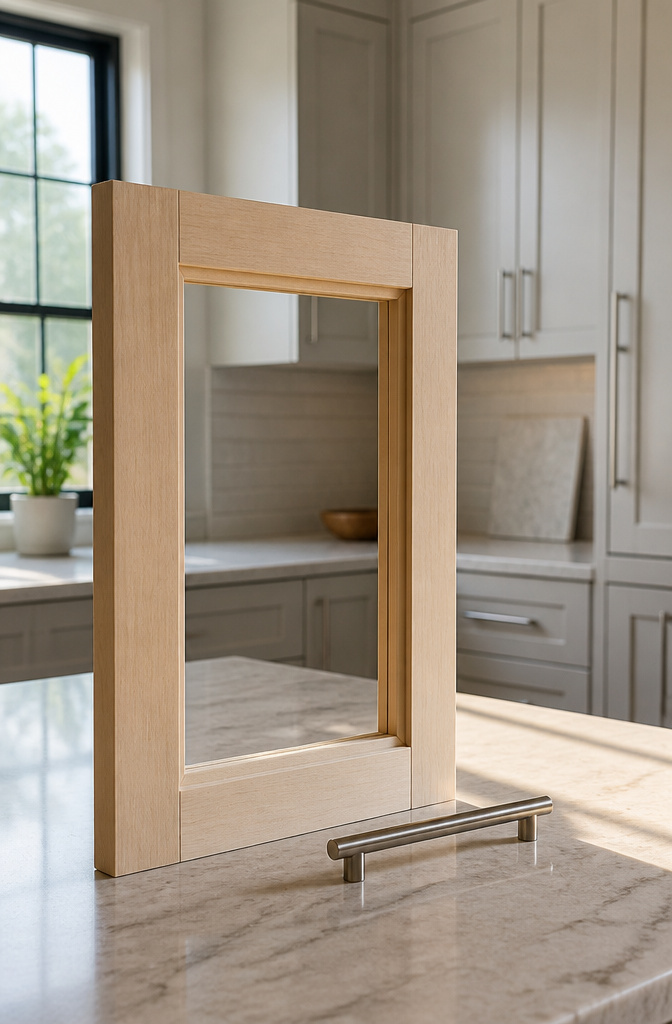
Glass-ready cabinet doors arrive with a groove routed into the back of the frame and no glass included. The standard thickness that fits is 1/8 inch, and you’ll need to source that yourself from a local glass shop. The unfinished back is slotted for the insert, and the door itself is 3/4 inch thick with stiles and rails that run anywhere from 2 1/8 inches up to 3 inches depending on the style you choose.
Installation gives you two methods. Decorative clips press into the slot from behind and hold the pane mechanically; silicone bead runs as a flexible seal around the edge. I prefer clips for a first project because you can pull the glass back out if it needs cleaning or replacement.
These doors take soft-close hinges without issue, which matters more than you’d think. Glass adds weight, and a door that slams puts stress on the frame and the pane both. Hinge boring is usually available from the supplier, placed 3 inches from top and bottom on most lines, though one maker offers 3 3/4 inches as an alternate. If you’re drilling your own, use a pilot hole. Hardwood frames split easily under direct screw pressure, and a cracked rail ruins the door.
Order only after you’ve picked your glass source and confirmed they stock 1/8 inch in the size you need. Lead time on custom-cut panes can stretch past the door delivery, and a framed door sitting empty is just a hole in your cabinet run.
Textured Glass Options
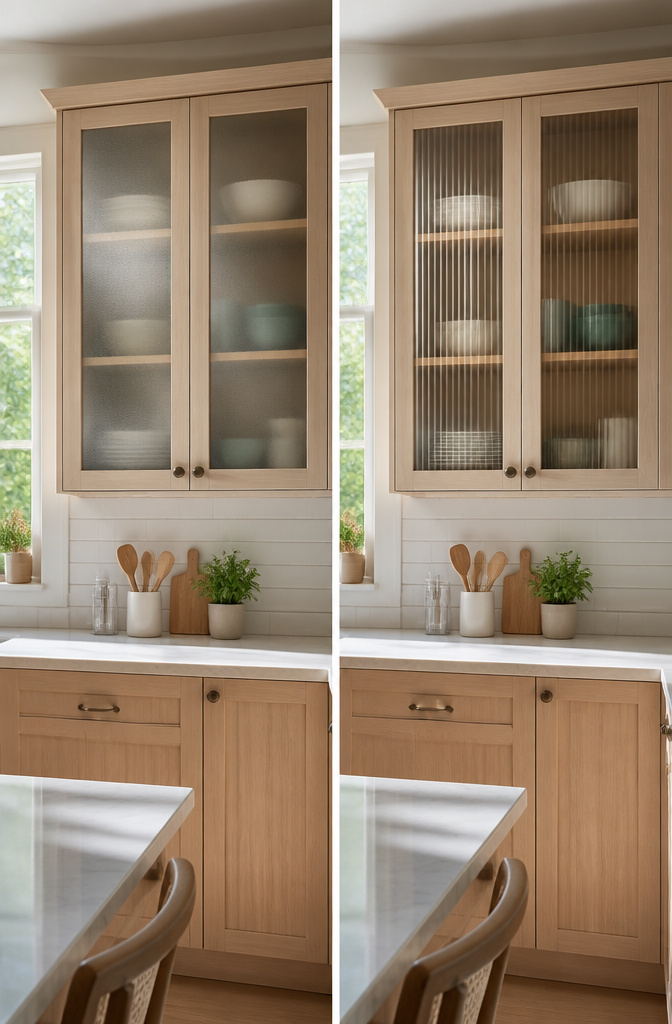
Frosted glass turns cabinet contents into soft silhouettes, a choice I made after watching a neighbor’s spice collection become the room’s busiest wall. The texture diffuses light so the door reads as a bright panel rather than a window, which matters in kitchens where dishes and storage containers rarely stay color-coordinated.
Ribbed and reeded glass add a finer layer of control. The vertical lines catch light in a way that reads almost like fabric from across the room, and they keep the eye on the door itself instead of letting it tunnel through to whatever’s behind. I prefer this when shelves hold everyday clutter rather than display pieces.
Patterned and seedy glass sit at different points on the same dial. Patterned glazing, like diamond or leaded rhythms, carries ornament without adding physical objects. Seedy glass, with its scattered bubbles and seeds, gives the oldest visual texture of the group. Up close you notice the distortion; from ten feet away it registers as gentle movement and warmth.
Textured glass hides fingerprints better than clear, a practical difference that shows up fast in a working kitchen. Ribbed surfaces collect grease along their valleys, though, so the wipe direction matters more than with flat frosted panes. The trade-off is worth weighing before you order: texture that reads beautifully at a distance can need more attention in daily use than the calm surface suggests.
Custom Glass Cabinet Doors
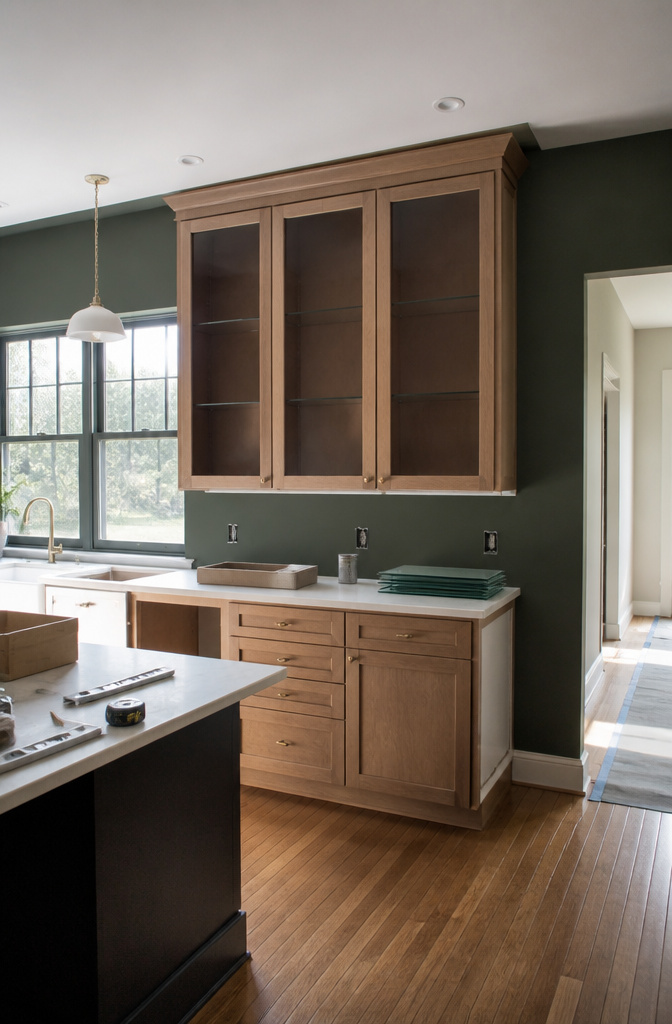
Standard cabinet doors come in predictable widths, but older kitchens and built-in hutches rarely cooperate with those increments. A gap of even half an inch between the door edge and the frame reads as a sloppy retrofit, not a design choice. Custom glass cabinet doors close that gap by building to the opening that actually exists, not the one a catalog assumes.
The measuring stage is where most custom orders go wrong. Cabinet openings are rarely square; the back of a frame can measure an eighth inch narrower than the front, and a door cut to the larger number will bind or hang crooked. Measure the opening at the top, middle, and bottom, and order to the smallest dimension minus the clearance the shop specifies. Most builders want three-sixteenths to a quarter inch total play for hinges to adjust. Skip that subtraction and the door arrives proud of the frame, and planing a glass-ready door after the fact is not a practical fix.
Lead times for custom work run several weeks against next-day stock sizes. The trade makes sense when you are matching existing cabinetry or working around a structural quirk a standard door would expose rather than solve.
Aluminum Frame Glass Doors
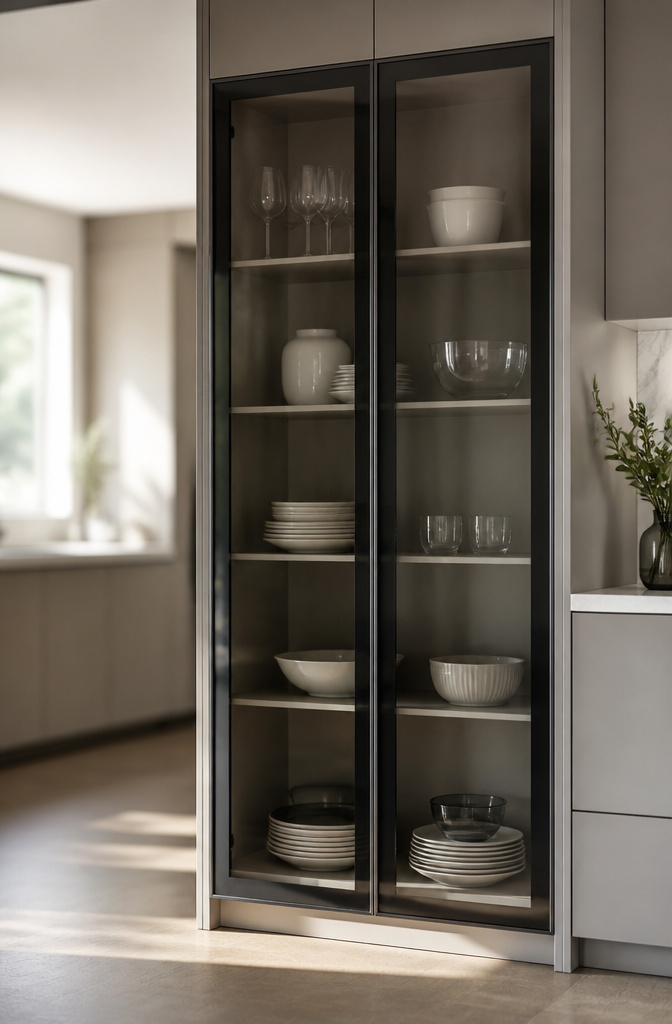
Aluminum frame cabinet doors read differently than wood the moment you step back from the installation. The metal frame sits as a thin, precise outline around the glass, and that thinness is where the weight difference lives: aluminum carries the same structural load in a slimmer profile, so the door face reads as more glass and less frame. Against stone counters or glazed tile, that metallic edge picks up the cool tones already in the room rather than introducing warmth the way oak or walnut would.
The construction leaves room for nearly any insert the manufacturer stocks. Satin glass, clear, frosted, reeded, seedy, the textured options from a typical kitchen supplier’s list: the aluminum frame accepts them all because the panel sits in a continuous channel rather than needing the deeper rabbet wood requires for stability. That channel also means the edge profile stays crisp, almost machined, where wood even when painted shows a slight rounding at the corner from routing or sanding.
Black aluminum behaves as architectural punctuation, the kind that needs repeating in small doses elsewhere: faucet lines, hardware, window trim. Without that echo, a single black-framed door can look like a graphic accident on an otherwise quiet wall. Brushed stainless or satin nickel finishes merge more easily, reading as neutral hardware extended across a larger surface. White painted aluminum does the opposite work entirely; the perimeter quiets down and the glass itself becomes the designed event, whether that is a frosted panel hiding dishware or a clear pane displaying it.
Sliding Glass Doors
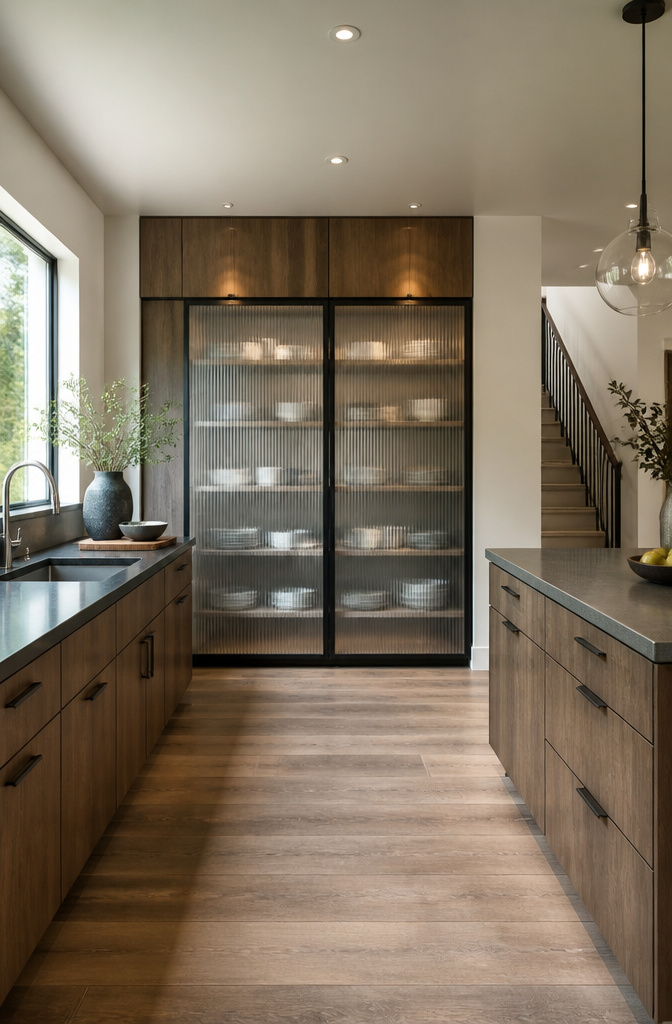
Sliding glass doors keep the front of a cabinet completely clear while the panel tracks sideways inside the frame. That matters in a galley kitchen or any run where a swing door would block the aisle or collide with a neighboring drawer when open. The hardware lives above and below the door rather than on the side stile, so the cabinet box needs a full top and bottom rail thick enough to house the track; a frameless European-style box often lacks the meat for this without a added sub-rail or a switched door style.
Upper cabinets suit them best. The motion is easy to manage at eye level, and the blur of ribbed or textured glass hides the contents enough that the space does not read as cluttered from across the room. Lower cabinets with sliding doors tend to collect drips and crumbs on the lower track, and bending to slide a door while holding a pot is awkward enough that I would rather swing or lift.
Where they do work, the sleek face line is the payoff. No hinges break the plane, and paired doors can meet in the middle with just a slim finger pull or a routed recess. The catch is that only half the cabinet is ever open at once. If you store tall pitchers or stacks of plates, the fixed overlap of the two panels cuts your access width by roughly fifty percent. That limitation is built into the mechanics, not a quirk of one brand or another.
What Glass Doors Change in a Kitchen
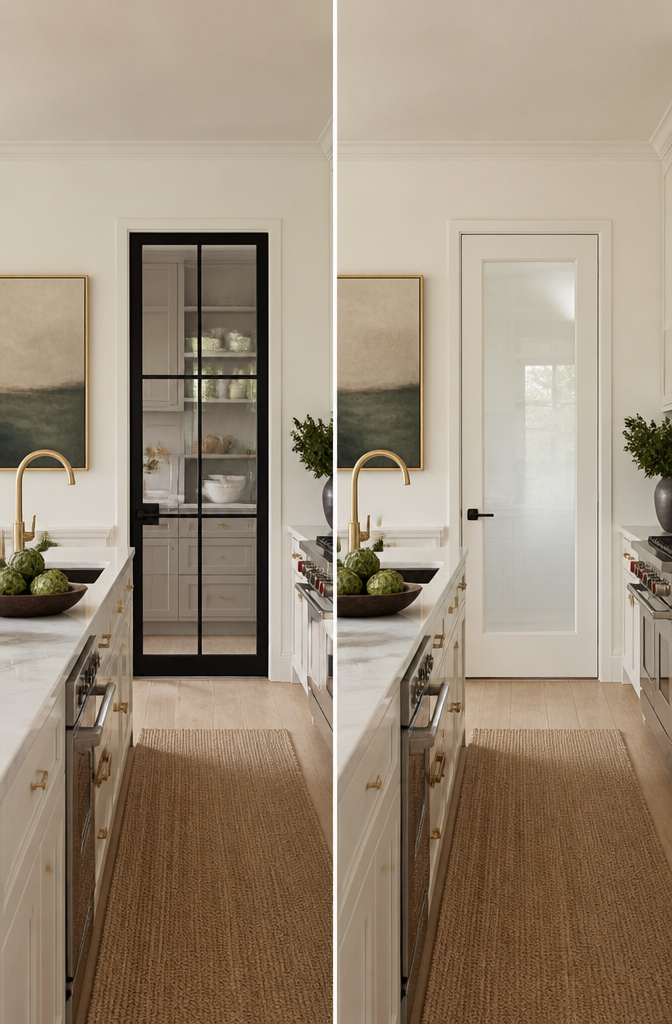
A glass door in kitchen cabinetry does something solid doors never manage: it borrows space from the room itself. The glazing pulls light through the front plane of the cabinet, so the wall stops reading as a hard boundary and the room gains a few perceptual feet. I noticed this first in a galley kitchen where a single row of clear-front uppers turned the back wall into a shallow stage; the dishes sat a hand’s depth behind the glass, and that small gap created enough illusion of depth that the aisle felt wider walking toward it.
Smaller kitchens benefit most, but the effect depends on what sits inside. Clear glass with mismatched storage reads cluttered, which collapses the sense of order that makes the depth trick work. Frosted or textured glass solves this by diffusing the contents into a calm glow, a controlled light value that finishes the wall without demanding curated objects. Under-cabinet lighting against textured glazing produces a warm base layer that keeps pale kitchens from turning sterile; the glass becomes a quiet feature rather than a mirror throwing back sharp reflections.
The display function matters too, though it is easy to overrate. A few kept pieces behind glass read as intentional; packed shelves read as storage with a visibility problem. The balance is functionality first, exhibition second. Glass doors break the monotony of repeated solid fronts, but they earn their place when they serve the room’s spatial psychology, not just its styling.
Installing Glass in Cabinet Doors
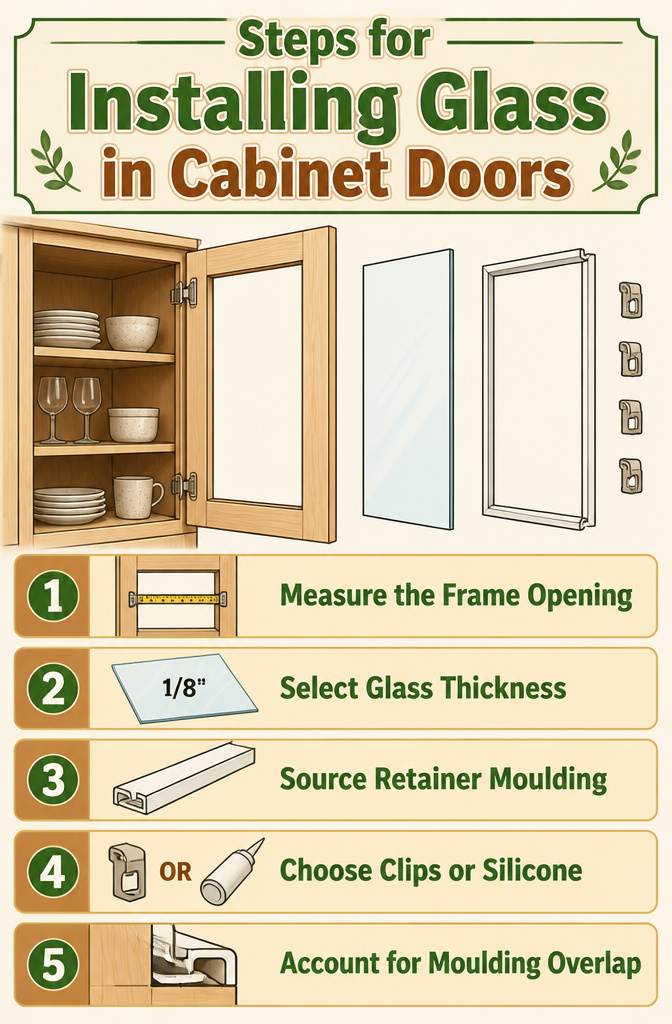
Measuring for a glass insert starts with the opening left by the door’s frame, not the door itself. Most mullion and glass-ready doors built for kitchen cabinets use a 1/8" glass thickness, which is thin enough to flex slightly during installation but heavy enough to feel solid when closed. The supplier slots the back of the frame for that thickness, and the retainer moulding clips into place behind it.
Some doors ship with that clear retainer moulding included; others leave the back unfinished and expect you to source your own clips or a bead of silicone around the perimeter. Silicone works fine for textured or seeded glass where the distortion hides any slight irregularity in the bead line, but with clear glass you will see every ripple. Clips give you the option to remove the glass later if a pane cracks or you want to swap in something with more privacy.
The framing stiles and rails vary by style, from 2 1/8" up to 3", so the actual glass size changes door to door even at the same cabinet width. Measure the slot depth too: a 5/8" mullion width sounds generous until you account for the moulding overlap.
Design Ideas That Actually Work
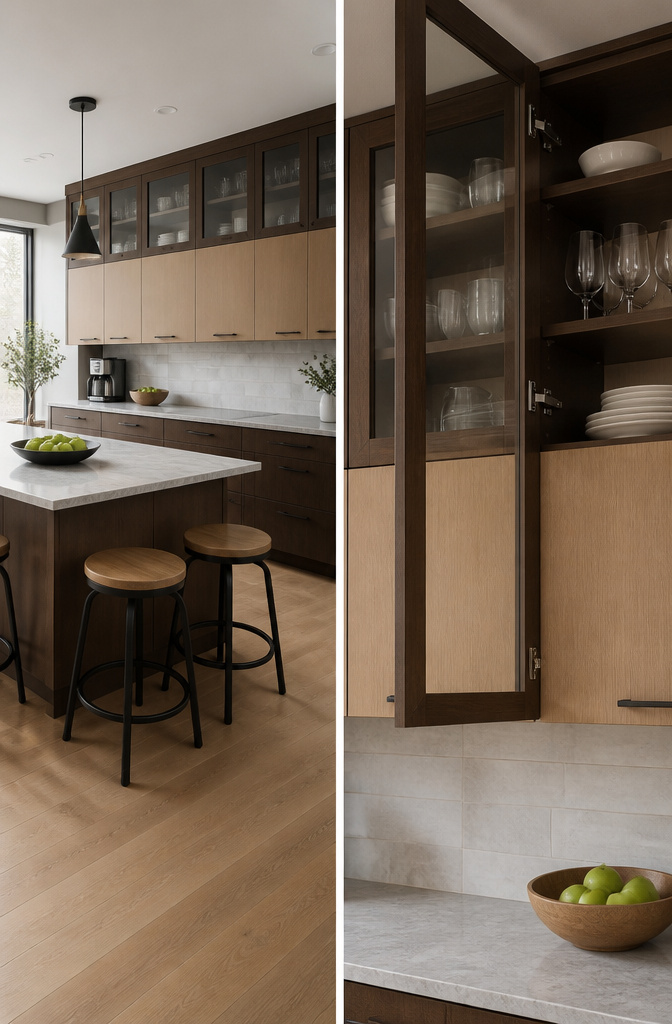
A kitchen with nothing but glass doors looks like a showroom, and real dishes never sit as still as the ones in those displays. The way out is mixing glass and solid doors on the same run, which breaks up the wall and gives you somewhere to hide the cereal boxes. I would put glass uppers at the ends or above the sink where the light hits, and keep solids in the middle for daily dishes that do not earn an audience.
Color choice matters more with glass because the frame becomes a visible line against whatever sits behind it. A dark mullion frame against white plates reads as intentional; the same frame against mismatched mugs looks like a mistake you are stuck with. If your dishes lean chaotic, a textured glass insert, reeded or seeded, blurs the contents without killing the depth that glass adds to a small kitchen.
The 1/8 inch glass the frames are built for is thin enough to stay light in the door, but that also means the contents press right up against the surface. Leave three inches of breathing room inside, or the stack of plates will read as a smear of color rather than a shape. In a rental where you cannot reface everything, swapping two upper doors for glass-ready frames and painting the frames to match the existing boxes fakes a custom look for the cost of a weekend and a brush.
Keeping Glass Doors Clean
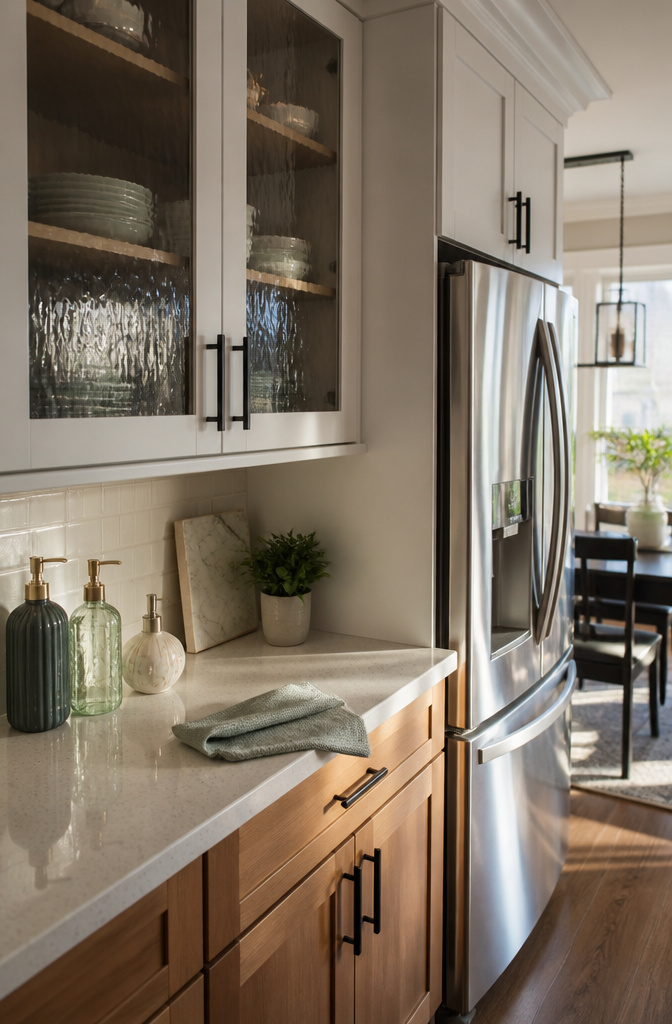
A glass door in kitchen cabinets collects grease faster than you’d expect, and the texture you chose determines how much of that film shows. Transparent glass makes every fingerprint and cooking-oil haze visible by afternoon, which is why I ended up wiping mine down almost daily when I had it. Frosted glass hides the smudges better, though the surface still holds grease and needs a real cleaning weekly or the finish goes dull. Textured or ribbed glass is the most forgiving; the ridges scatter light so the oily film doesn’t read as obvious smears, though the grooves themselves trap residue and need a cloth wrapped around a thin tool to reach into.
The right cleaner matters less than the cloth. Paper towels leave lint on frosted finishes, and anything abrasive scores the textured surface permanently. A soft microfiber with plain dish soap handles the grease without attacking the finish. Skip ammonia-based sprays on textured glass; they seep into the grooves and leave a cloudy residue that reads from across the room. Ribbed or slatted glass buys you the most time between cleanings, but when you do clean it, plan on working each ridge by hand.
Frequently Asked Questions
Are glass kitchen cabinets a good idea?
A glass door in kitchen cabinetry borrows perceptual space from the room itself by pulling light through the front plane, which makes walls feel less like hard boundaries. The effect works best when contents are curated or when textured glass diffuses everyday clutter into a calm glow. Clear glass with mismatched storage reads as chaotic and collapses the depth illusion, so the choice depends more on what sits inside than on the door itself.
How do I install glass in glass-ready cabinet doors?
Use decorative clips pressed into the rear slot from behind, or run a silicone bead around the edge as a flexible seal. Clips allow removal for cleaning or replacement, which makes them the safer choice for a first project. Most kitchen cabinet doors are slotted for 1/8 inch glass, and suppliers usually place hinge bores 3 inches from top and bottom unless you request an alternate spacing.
What types of glass can I use with glass-ready cabinet doors?
Options include clear, frosted, textured, ribbed, reeded, seedy, and patterned glass, with tempered glass being the standard for durability. Frosted glass turns cabinet contents into soft silhouettes, while ribbed or reeded glass keeps the eye on the door surface rather than letting it tunnel through to what’s behind. The 1/8 inch thickness fits standard cabinet door slots, though you must confirm your local glass shop stocks it in your exact size before ordering.