

Country kitchens run from weekend paint jobs to full gut renovations, and the difference between cozy and costume usually comes down to whether the materials carry any history. Reclaimed wood with visible nail holes, stone with natural pitting, and brick with softened edges do what new products cannot: they make the room feel borrowed rather than bought.
1. Natural Materials
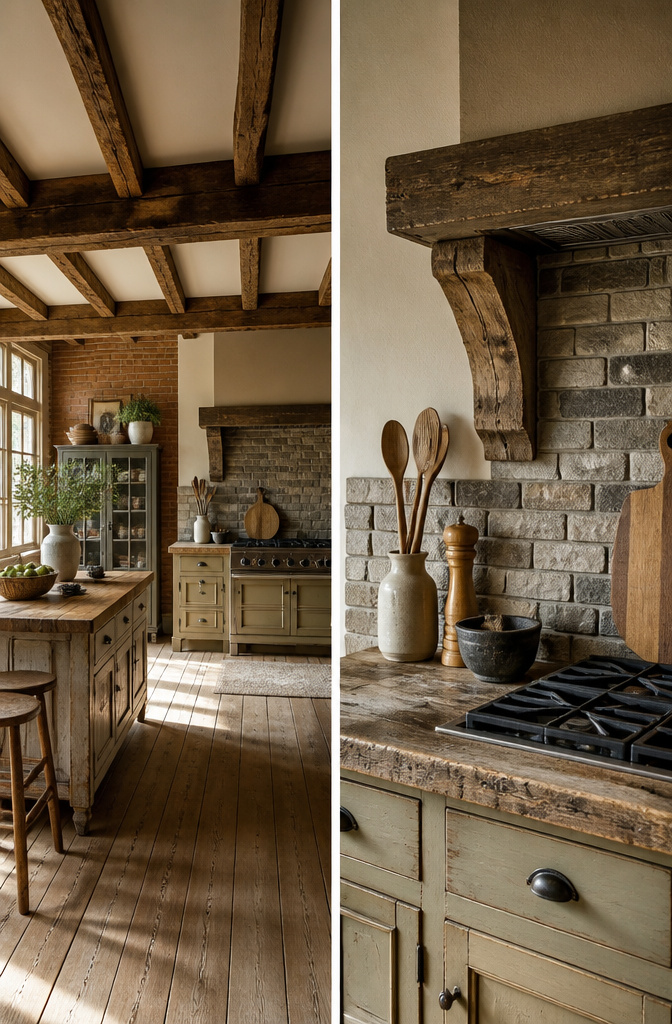
Wood, stone, and brick give a country kitchen its bones, and the trick is using them where they already exist or where you can add them without gutting the room. In my own search for kitchen ideas country style, I kept noticing that the spaces that felt genuinely lived-in almost always had one raw material left exposed: ceiling beams pulled back from drywall, a single stone backsplash behind the range, or a brick wall stripped of plaster.
Exposed ceiling beams read as structural even when they are not. You can install hollow box beams from natural oak or walnut if the originals are missing, and the visual weight does the same work of breaking up flat ceiling planes. Stone works best where splatter meets texture, so behind a cooktop or prep sink. Slate or limestone backsplashes wear in rather than wearing out, and the slight unevenness hides the mess of actual cooking better than glossy tile ever could. Brick accent walls demand more commitment, but a single wall of salvaged brick, or brick-veneer panels if the structure cannot take the load, gives the room an immediate sense of age that new materials struggle to fake.
The worn or aged finish matters more than the material itself. Reclaimed wood cabinetry with visible nail holes, stone with natural pitting, brick with softened edges: these carry the history that makes a country kitchen feel borrowed from an old farmhouse rather than installed last weekend. That lived-in quality is what separates the look from plain rustic; it is the difference between a kitchen that photographs well and one you actually want to stand in at six in the morning.
2. Warm Color Palette
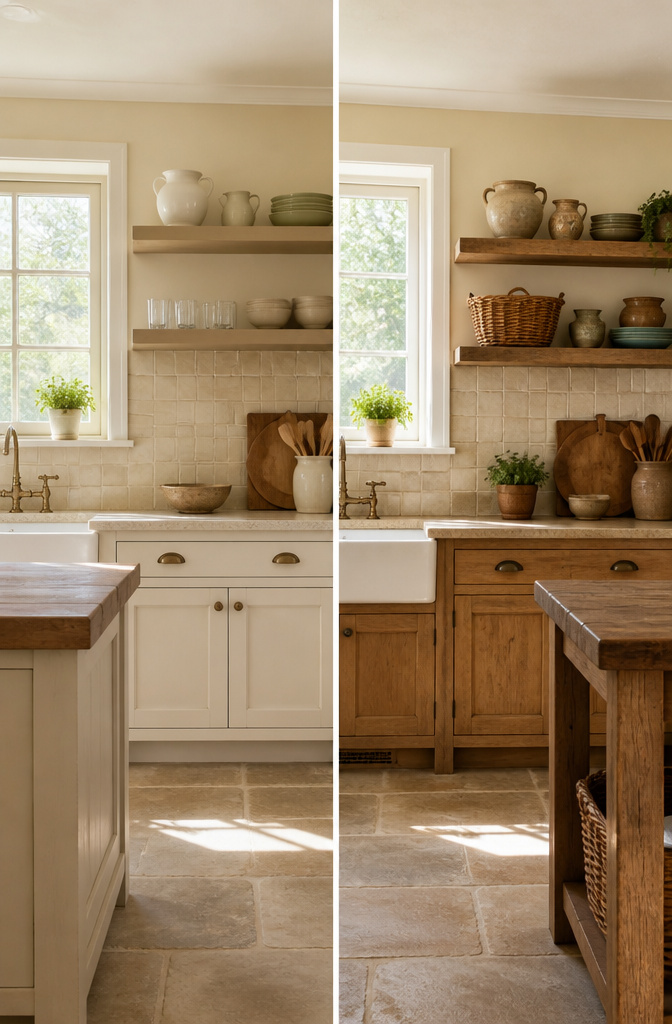
Soft whites, creams, beiges, and warm wood tones set the tone in a country kitchen without turning the room into a blank box. The warmth comes from layering: cream cabinets against a barely-there beige wall, or soft white trim that frames a window looking out on nothing more exotic than the neighbor’s fence. An all-white kitchen is the mistake that reads sterile, the one that strips out the personality people actually want from farmhouse style. I learned that the hard way watching a friend’s renovation go from "airy" to "hospital corridor" in about a week of paint drying.
Earthy shades like sage green or muted blue work as accents, not centerpieces. A pale green hutch against cream walls gives the eye somewhere to rest. Natural wood finishes on open shelves or a butcher block island bring in the warmth that paint alone cannot manage. The goal is inviting, not thematic. Skip the literal farmhouse signs and let the colors do the work of making the kitchen feel lived-in.
3. Vintage and Antique Accents
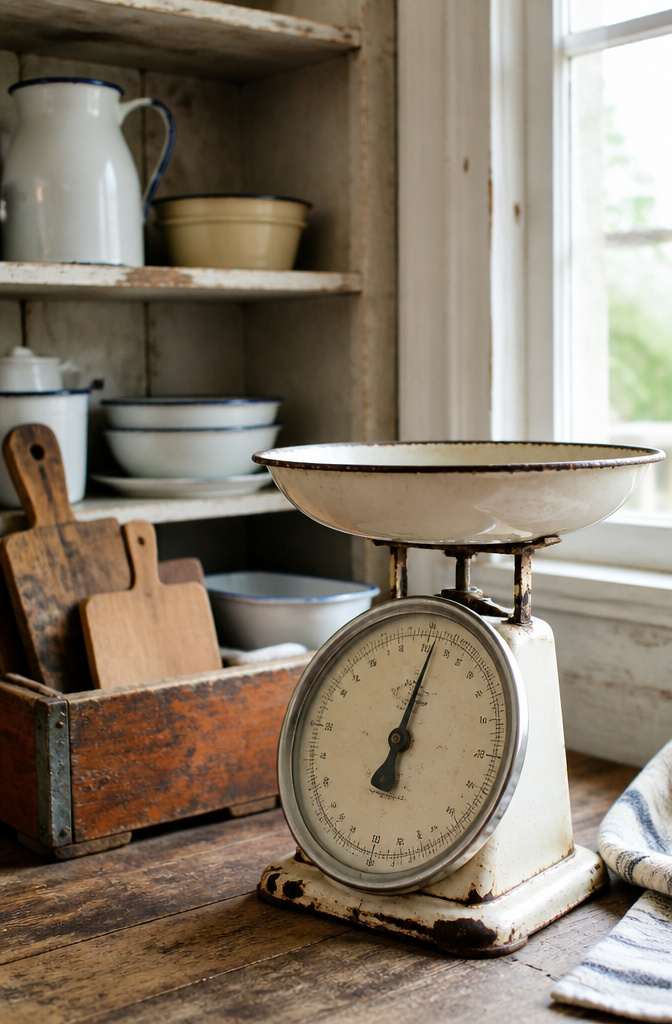
A vintage scale on the counter does more than look period-correct. The enamel surface catches light differently than anything new, and the dial face gives the eye somewhere to rest that isn’t a screen. Old scales run $40–$80 at estate sales, but thrift stores and Facebook Marketplace usually price them at half that because the seller just wants the weight gone.
Enamelware bowls and pitchers work the same way. White with a blue rim, or cream with a thin green stripe, they stack on open shelves without looking staged. The chips and rust spots are the point; they signal use instead of a catalog purchase.
Crates are the cheapest entry point. A 1940s Coca-Cola crate, still slatted and stamped, costs about $15 at flea markets and holds cutting boards upright against a backsplash. Wine crates from grocery stores work too, though they need a quick sanding to lose the splinters. Stack two for a side-table beside a farmhouse table, or line one with oilcloth and set it by the door for root vegetables.
The mistake is buying too many pieces at once. Three items with real age outlast a dozen reproductions, and the kitchen stops feeling like a set and starts feeling like something inherited. That inheritance effect is what country style actually is, not the individual objects.
4. Open Shelving and Display
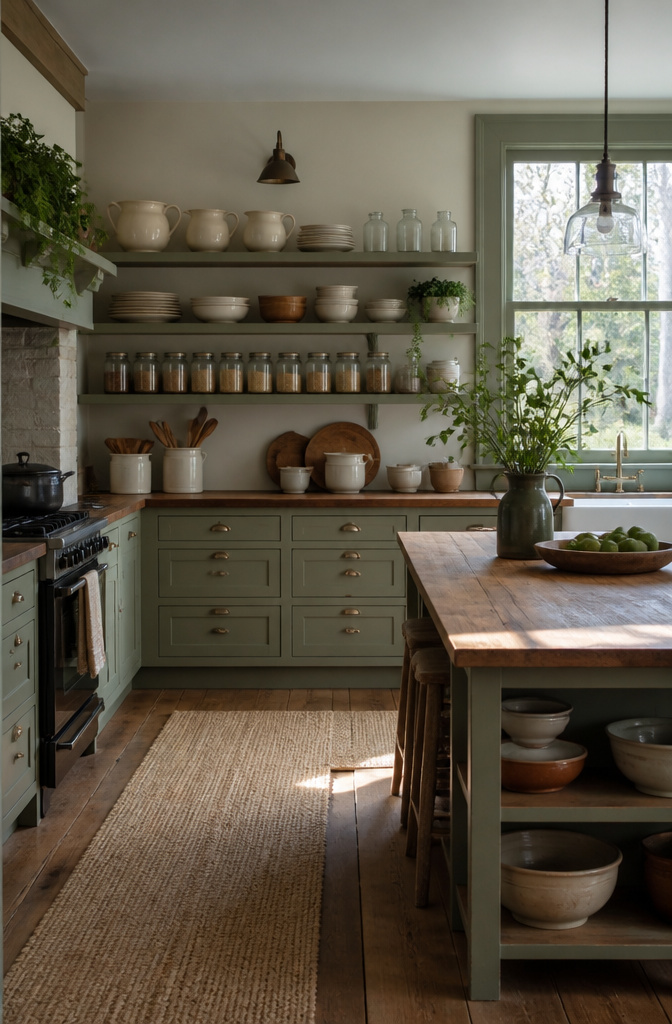
Open shelves in a country kitchen put everyday plates and bowls where your hands can reach them, but the line between lived-in and messy is thinner than most people expect. The sources agree on the tension: one calls the look "clutter-free yet functional," while another straight-up welcomes "quaint clutter." Two ways to play this. If you want the curated side, stick to a single color family for whatever sits on display; cream stoneware and clear glass read intentional even when the stack is imperfect. If you want the warmer, more maximalist feel, let the items do the mixing, but group like with like so the eye reads order instead of noise. A row of mason jars holding pantry staples, all the same size, anchors a shelf better than three different containers shoved together. The country kitchen is supposed to look used, but the trick is making sure the daily-use items are the pretty ones. That chipped mug you actually drink from earns its spot; the stained plastic cup does not.
5. Farmhouse Sink
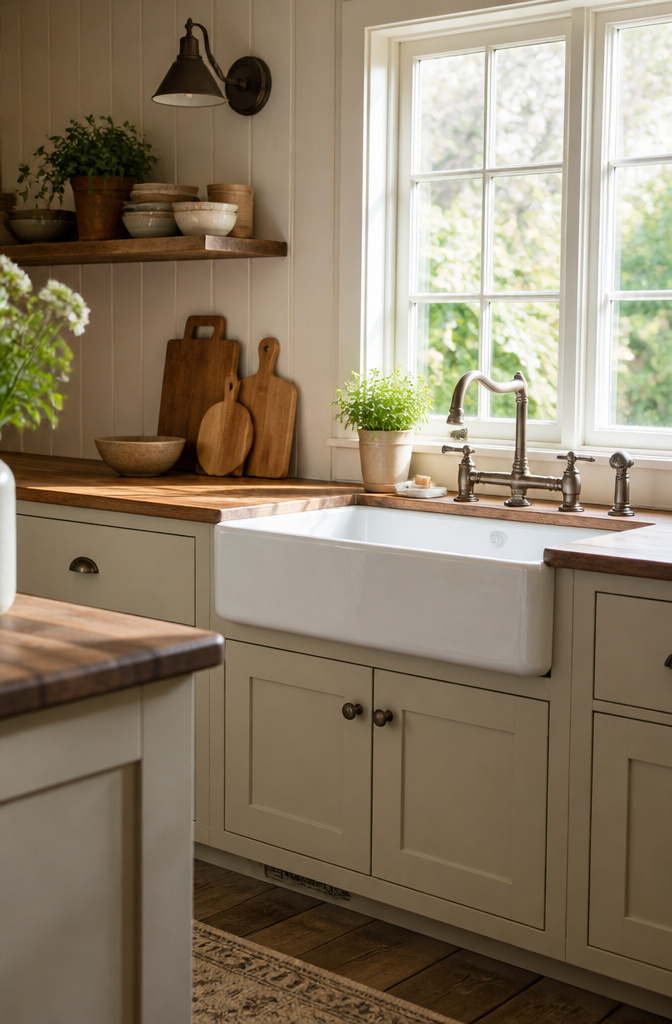
An apron-front sink sits forward of the cabinets, and that extra depth is what makes it worth the cabinet surgery. Pots that don’t fit in a standard basin lie flat in the bottom. You can rinse a cutting board without splashing the counter. The basin itself becomes a workspace, not just a drain.
The weight is the part nobody warns you about. Fireclay or cast iron, you’re looking at roughly 200 pounds empty, and your wall cabinets won’t carry that. The base cabinet needs a reinforced frame, sometimes a entirely new box, which turns a weekend swap into a two-weekend job if you’re doing the work yourself.
Compared to a drop-in, the front is always exposed, so drips dry on porcelain instead of hiding under a lip of stainless steel. That look is the whole point, but it also means choosing a finish you’ll still want to see in five years. White fireclay yellows slightly; darker colors show water spots differently. The daily tradeoff is cleaning what you can see versus never really knowing what’s pooling under a rim you can’t reach.
6. Wooden Cabinets
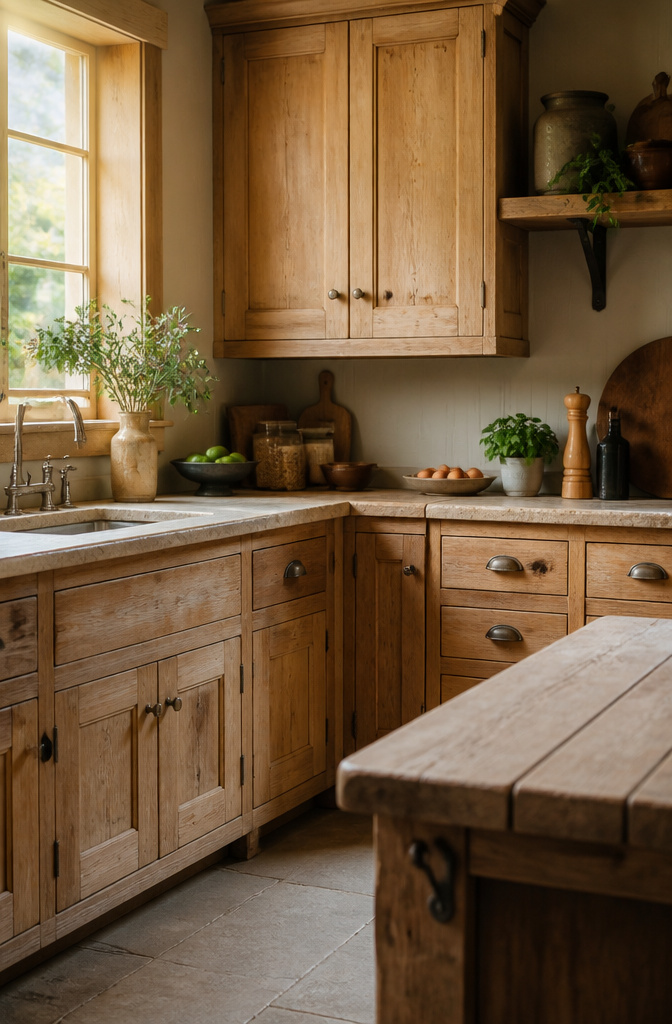
Unfinished or distressed wood cabinetry sits at the center of most country-style kitchens, and the difference between the two finishes matters more than the names suggest. Distressed wood is deliberately worked to look worn, not actually damaged: corners get softened with sanding, paint layers are built up and partially sanded away, and small dings are added with chains or awls in a pattern that reads as age rather than neglect. Unfinished wood skips all of that and stays raw, which gives a more authentic, rough-hewn feel but also means every spill and fingerprint shows until you seal it yourself.
Pine, oak, and maple take distressing better than denser species because their grain structure catches the light unevenly after sanding, which sells the illusion of decades of use. Pine dents easily, which some people consider a flaw and others call the whole point; oak holds texture longer; maple splits the difference. Walnut works too, though it reads as slightly more refined than the rustic core you’re usually after.
Buying cabinets already distressed costs more but the finish is consistent across every door. Doing it yourself takes a weekend, a random-orbit sander, and the willingness to stop before you overwork it; the most common mistake is sanding too far and ending up with smooth wood that looks merely dirty, not aged. If you rent, stick to ready-finished and save the experiment for hardware you can take with you.
7. Painted Cabinets
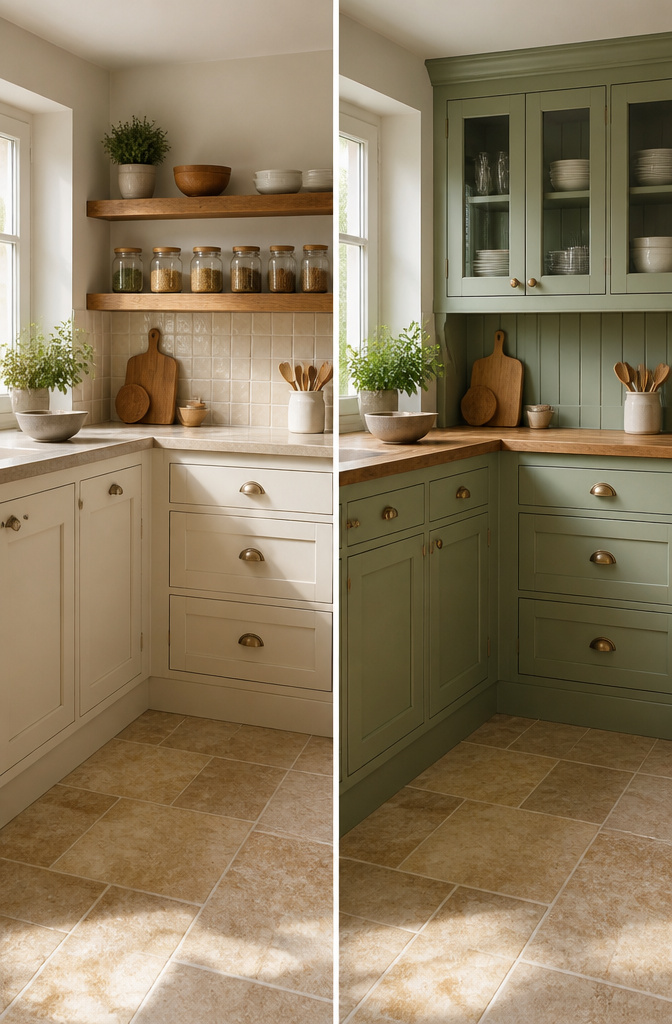
Painted cabinets give a country kitchen its airiness without stripping away the rustic feel that makes the style appealing. Soft whites, creams, and beiges keep the space bright yet cozy, while sage green or muted blue introduces just enough color to feel lived-in rather than sterile. The finish matters as much as the hue: a satin or semi-gloss sheen repels grease and moisture far better than flat paint, which will stain and scrub away within months.
The prep work is what separates a two-year paint job from a ten-year one. Every cabinet door needs thorough cleaning, light sanding, and a bonding primer before the color goes on. Skip the deglosser or rush the dry time between coats, and the paint will chip at the edges exactly where hands pull every morning. I have watched enough kitchen rescues to know that the people who block out a full weekend for prep and light coats are the ones who do not repaint three years later.
8. Butcher Block Countertops
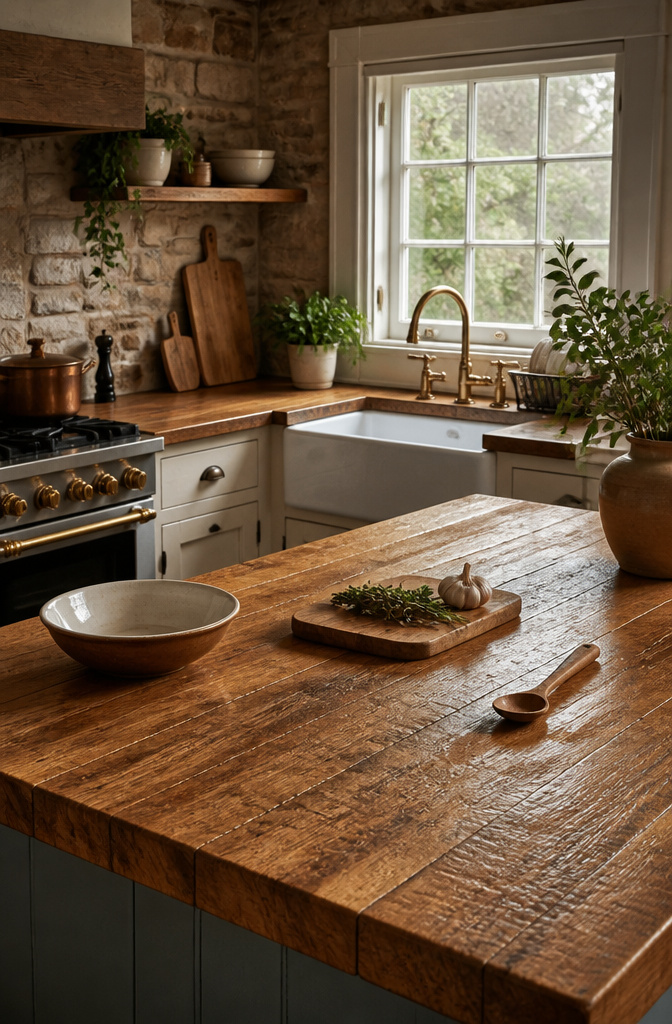
Butcher block brings a warmth no laminate can fake, and the surface earns its keep in a working kitchen. You can chop straight on it, and when the knife marks build up, a quick sanding and a fresh coat of mineral oil makes the damage disappear. That repairability is the whole appeal; the surface is meant to look used.
The maintenance is real, though. Oiling needs to happen every few weeks at first, then monthly once the wood is saturated. Skip it and the block dries out, which invites cracks. Water is the bigger threat right by the sink. Pooled water will blacken the grain in a season, so wiping the counter dry after dishes matters more than any oiling schedule. A small lip or a careful caulking job at the backsplash buys you insurance there.
The scuffs and light stains that accumulate are not flaws to hide. They read as the history of actual cooking, which is exactly what country style is supposed to show. I would take a scarred butcher block over a pristine quartz counter every time in this kind of kitchen; the quartz looks like you are waiting for permission to cook, and the wood looks like you already have.
9. Marble and Granite Countertops
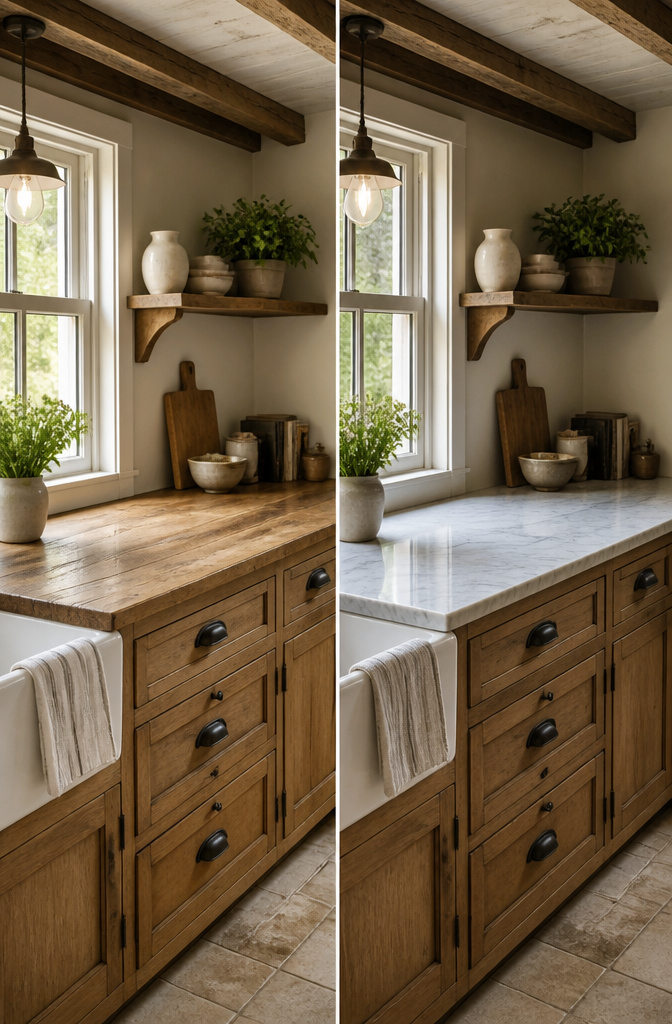
Stone countertops in a country kitchen work best where they earn their keep. I would put marble on the island or a dedicated baking zone, places where the cold surface actually helps and where the mess is concentrated enough to justify the splurge. Everywhere else, butcher block holds up fine for half the cost or less, and the warmth keeps the room from feeling like a showroom.
Marble patina is where the story lives. The first wine stain or etch mark looks like a disaster; by the third year the surface reads as history, not damage. That shift is the difference between a kitchen you live in and one you perform maintenance on. Granite plays the same role with less drama if you cook hard and wipe down less often than you mean to.
Neutral colors, white through gray to beige, keep the stone from competing with the wood and metal that actually define country style. A slab with too much movement fights the salvaged table or the distressed cabinets rather than finishing them.
10. Hardwood Floors
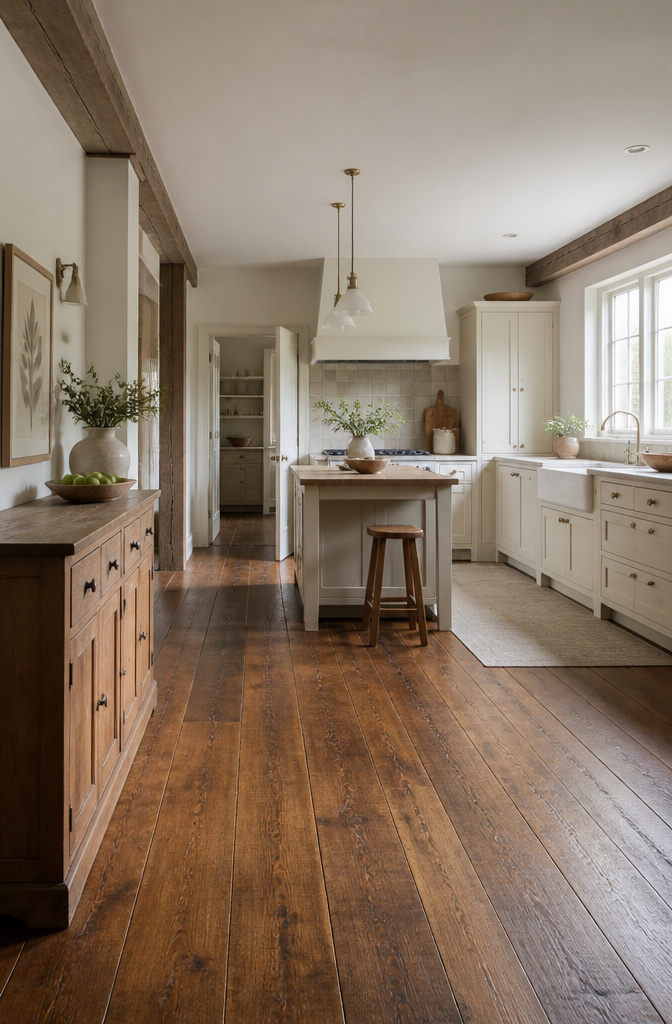
Wide planks read more country than narrow strip flooring, and the gap between them matters more than most people notice at first. Oak or walnut in a darker tone grounds the room and hides the crumbs that collect along the edges, while pine or ash lifts the light if the kitchen runs short on windows. A distressed or worn finish does the real work: small scratches from dropped pans or chair legs disappear into the surface instead of screaming for attention. I spent hours once comparing samples side by side, and the satin-finished oak with hand-scraped texture won because it looked already lived-in rather than already tired. Satin or matte finishes hide kitchen traffic better than anything glossy, which turns every water spot and scratch into a mirror you do not want. Species choice splits on how hard you are on floors. Oak tolerates the abuse; pine dents if you look at it wrong but costs less and ages into that beat-in farmhouse character some people pay extra to fake.
11. Stone or Brick Flooring
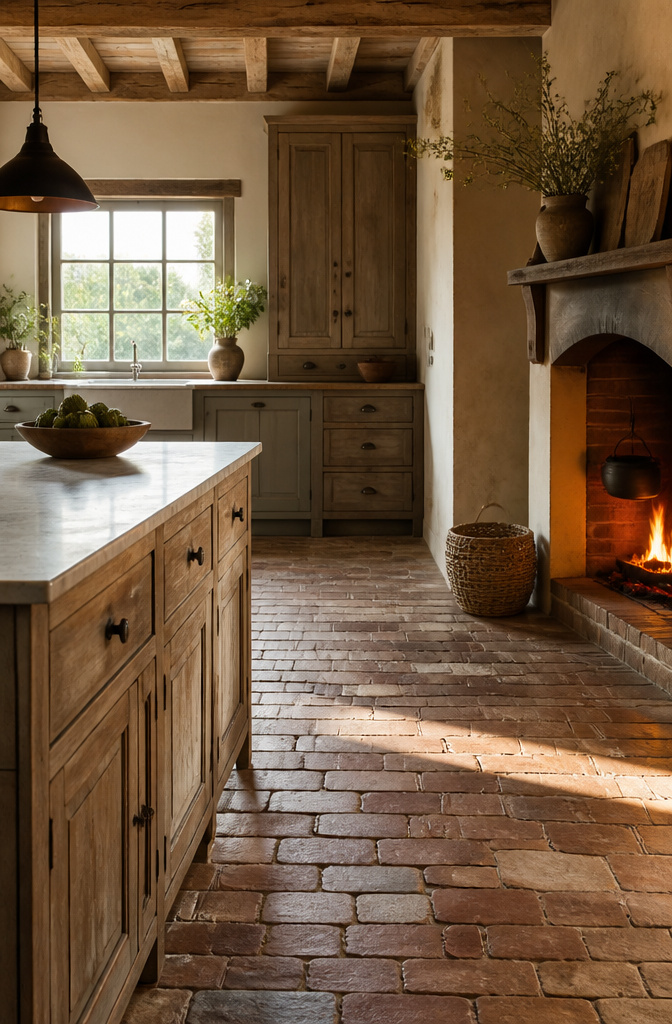
Stone or brick flooring gives a kitchen the kind of weight no laminate can fake. Slate, limestone, or actual brick pavers carry that farmhouse texture underfoot, but the sources that push them as cozy rarely mention the cold. In a north-facing kitchen or a house with crawl-space foundations, that chill starts at your ankles and works up through a full morning of standing at the stove.
The placement matters more than the material. Stone holds up beautifully at a mudroom entry where boots track in grit, or in the hearth zone around a wood stove where its thermal mass actually helps. Those are the zones where the rustic look earns its keep. Run it wall-to-wall in a prep kitchen and you are committing to thick socks and a rug that slides around.
Grout is the other conversation nobody starts. Wide joints between bricks or rough-cut flagstone collect grease and flour dust the way hardwood does not, and sealing them once is not a one-and-done. The resealing interval depends on traffic, but skipping it turns the lines between stones into a permanent gray shadow that no mop fixes. If you are already budgeting for the install, budget for a grout brush and a weekend of maintenance every year or two.
12. Wicker Baskets
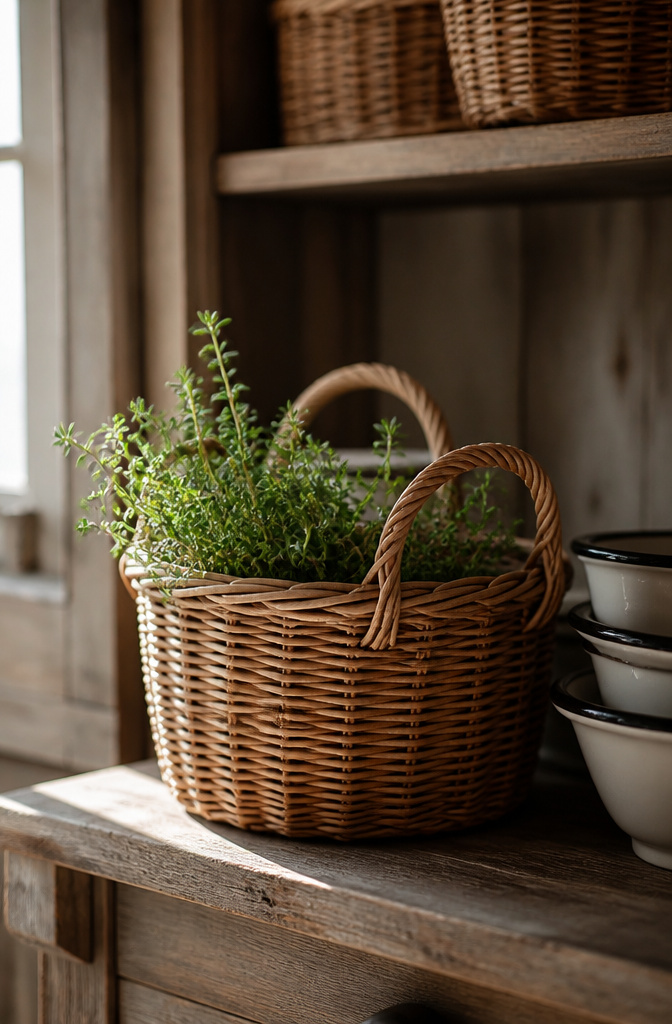
Woven storage brings warmth to open shelving in a way that painted canisters never quite manage. The natural texture catches light differently throughout the day, and in a country kitchen that lived-in quality is the whole point.
Sizing matters more than most people expect. A basket that sits too deep on a standard shelf wastes the front half as a graveyard for expired spice packets; one that sticks out past the edge collects grease from cooking and reads as clutter from across the room. Aim for a basket about two inches shallower than your shelf depth, leaving that front lip clear so you can actually slide it out without knocking the one beside it.
Onions, garlic, and bread store well in wicker because the weave breathes. Linens work too if the basket itself stays dry. Anything damp is a mistake; the fibers will soften and eventually mildew, and the smell lingers longer than you’d think. I learned that one the hard way with a basket of dish towels I’d tossed in still slightly wet.
Dust and grease accumulate in the weave over time, especially near the stove. A vacuum brush attachment pulls out loose debris, then a barely-damp cloth with plain dish soap handles the film. Let it dry completely before you fill it again, or you’re back to the mildew problem.
13. Mason Jars and Crocks
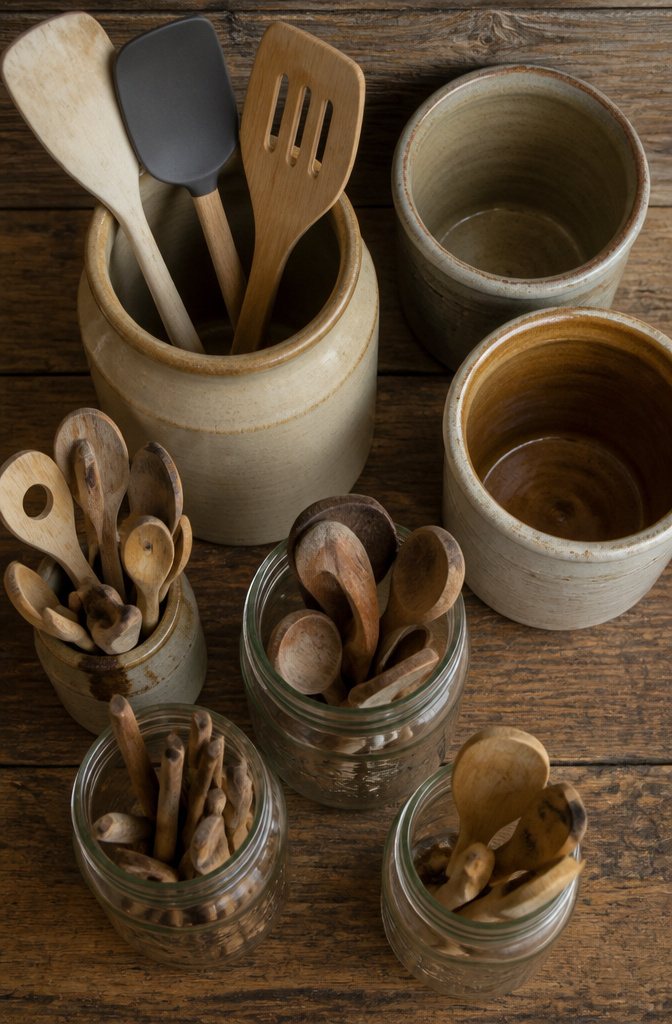
Glass jars and stoneware crocks read as collected over time, not bought in a single afternoon. The difference sits in what you leave empty versus what you fill. A crock with nothing in it, turned on its side to catch light on the rim, works as a shape. A jar holding the wooden spoons you reach for twice a day earns its shelf space by use. The ones that fail are the rows of matching containers, all full of nothing the cook actually touches, lined up like a catalog photo.
Daily-use jars belong where the work happens: flour and oats within arm’s reach of the prep counter, utensils in a crock by the stove. Decorative empties do better on the high shelf or the back of a deep windowsill, where they catch light without blocking function. Two or three mismatched sizes, some with wire bails and some without, carry more weight than a dozen identical quarts. The same rule holds for crocks: one tall stoneware piece for the slotted spoons, a squat one for nothing at all, and the eye reads kitchen rather than craft store.
The line between collected and cluttered is use. If every container holds something you touched this week, or nothing at all by intention, the arrangement holds. If half hold the wrong things and the rest hold air, the shelves start to look like storage for storage’s sake.
14. Copper or Cast Iron Cookware
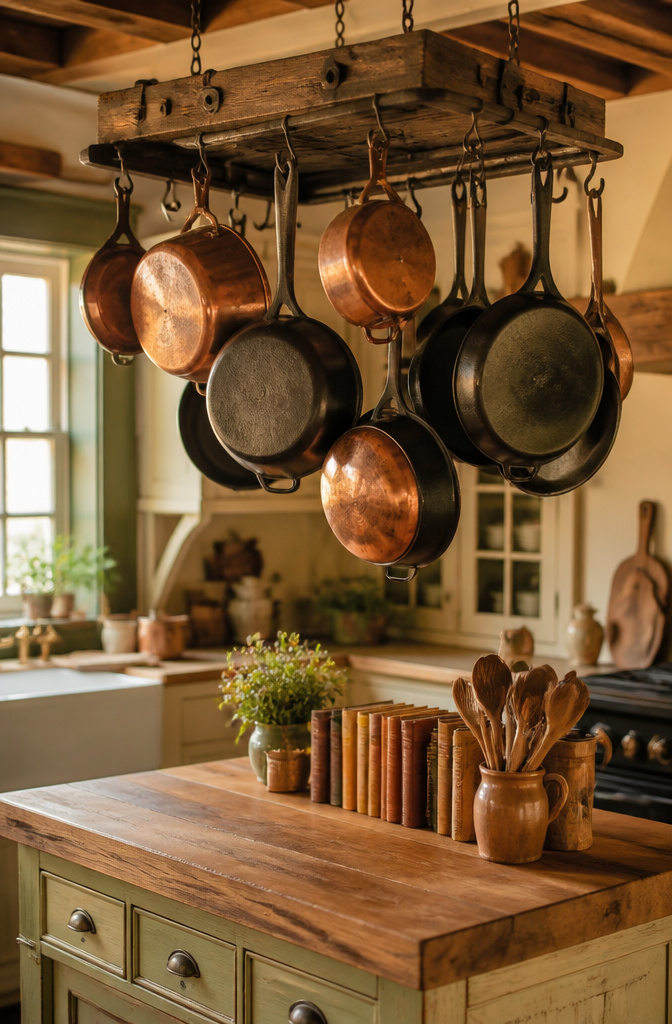
Wall-mounted racks and hooks turn the pots you already own into the kitchen’s decoration, which is the whole point of a country kitchen: it is supposed to look lived-in, not staged. The trick is weight limits matter more than style here. Cast iron skillets run eight to twelve pounds apiece, and a full set of copper can double that. A rack that sags after six months wrecks the look and the drywall.
I have read enough install stories to split the choice into two camps. Ceiling-mounted pot racks with lag bolts into joists handle the load honestly; wall-mounted rails with S-hooks look lighter but need to hit studs or collapse into a very expensive crash. Open shelves are the middle ground, and they keep everyday items within easy reach while maintaining that traditional, country feel.
Whether the copper actually sees flame is a personal call. Displayed cookware works either way, but the kitchens that feel genuine tend to use what they show. A wall-hung cast iron pan that never cooks is still a pan; one that comes down twice a week for cornbread earns the farmhouse look it projects.
15. Farmhouse Table
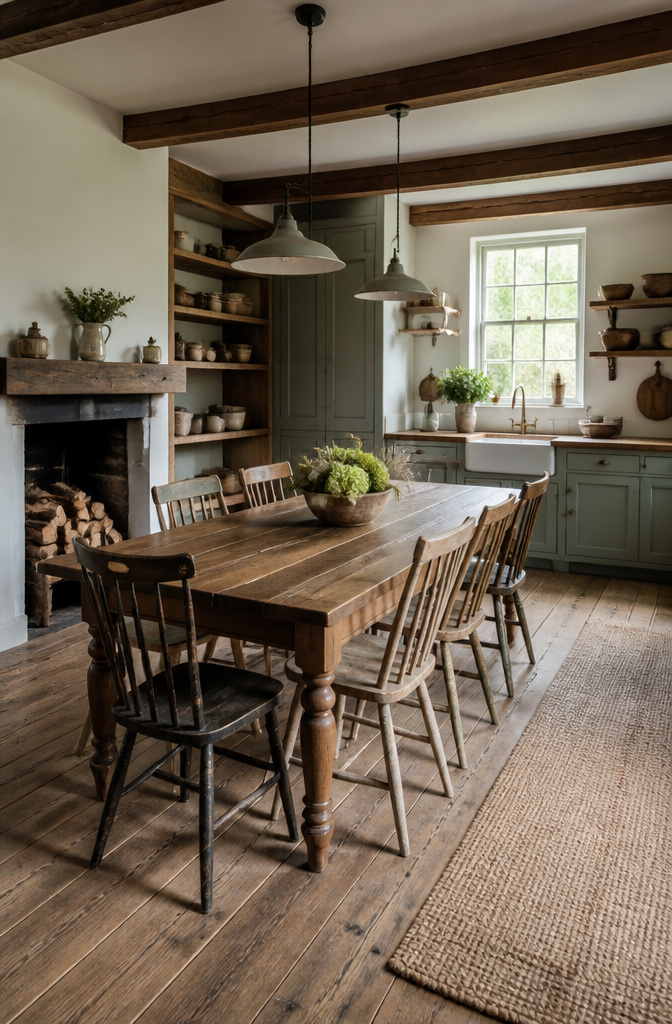
A substantial wood table anchors a country kitchen more reliably than any other single piece. The proportions matter more than the pedigree: a surface 36–42 inches wide leaves room for plates and elbows without blocking traffic in a standard 10-foot galley, while length should scale to the wall, not to some imagined banquet. Drop-leaf or gate-leg versions shrink to 18 inches when folded, which is the difference between a workable prep station and a hallway obstacle in a rental kitchen with no dining room to escape to.
The finish is where most tables fail in real use. Oil-based polyurethane in a satin sheen survives hot pans left half a second too long and the acetone in nail-polish remover when homework sprawls across dinner. Wax or raw linseed oil looks authentic but demands reapplication every few months; most people will not. A distressed top already carries dents, so the first scratch from a casserole dish reads as character rather than regret. That psychological shift, from protecting a surface to using it, is what makes a farmhouse table functional instead of merely decorative.
16. Country-Style Lighting
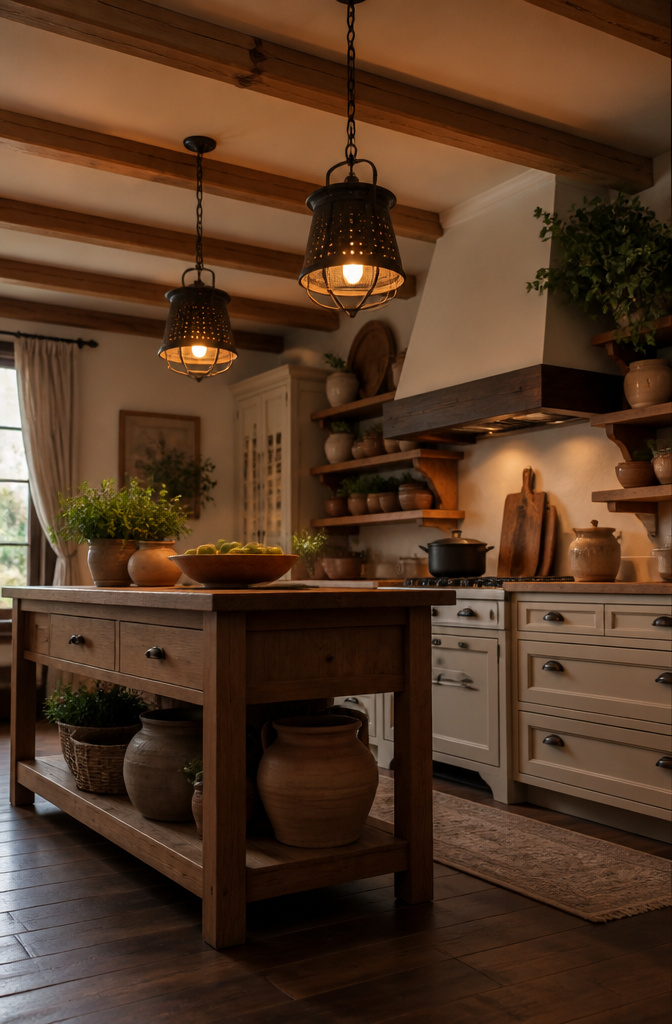
Lantern-style fixtures, wrought iron frames, and punched-tin shades do the heavy lifting for country kitchen atmosphere. They read as collected rather than installed, which matters in a style built on the impression of gradual accumulation.
Pendants over an island need to stay in scale or the whole room tilts off balance. A rule that held up across the kitchens I studied: the fixture diameter in inches should land roughly where the island width in feet sits. A three-foot-wide island carries a pendant around 12 inches across; four feet, closer to 16. Hang them 30–36 inches above the countertop, measured to the bottom of the shade, and keep the total wattage pooled across all pendants enough to actually work by.
Dimmable circuits are non-negotiable in a kitchen that shifts from cooking to gathering. Full output for dicing onions at six, then dial it back to where the same room feels like a place to sit with a drink. The sources kept circling back to this, and the kitchens that pulled it off all had the dimmer in place from the start rather than retrofitted later.
LED retrofits have gotten good enough to preserve the look of old shades and punched tin without the heat or the wattage draw. The color temperature is the detail that betrays you: aim for 2700K, the warm end, so the light coming through that aged metal or fabric shade still reads as firelight rather than clinic.
17. Distressed Wood Furniture
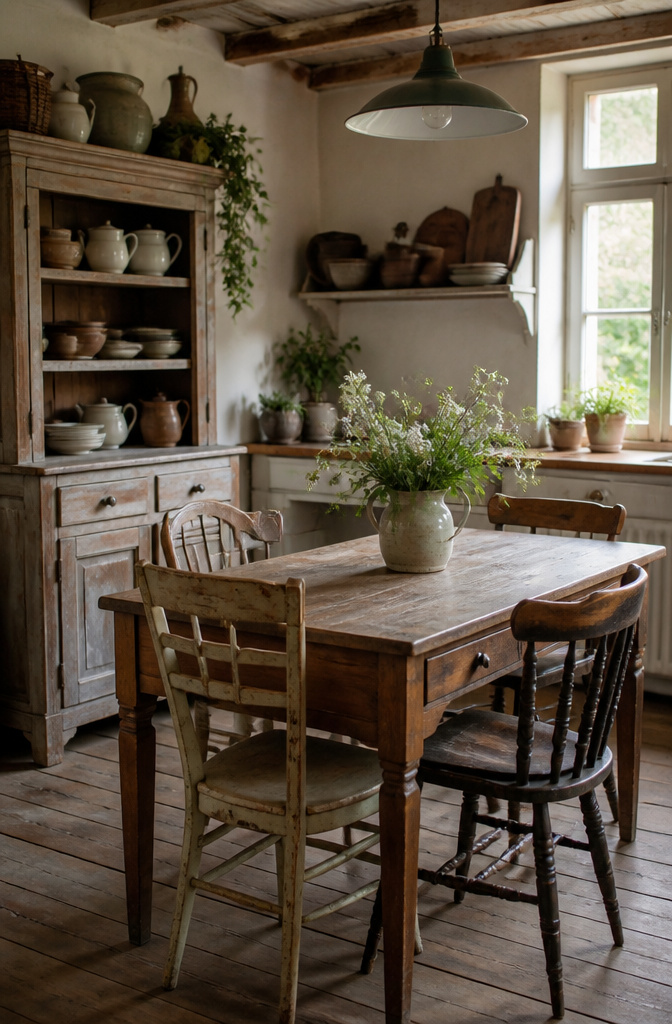
Weathered texture on tables, chairs, or islands adds depth without the flatness of matching sets. The trick is knowing what kind of wear you’re actually looking at. Genuine age shows uneven patina, soft edges from decades of hands, and wear patterns that make sense for how the piece was used. Intentional distressing from a factory or workshop mimics this but tends to repeat the same dents and scratches across a whole line. Damage is something else entirely: water warping, structural cracks, or rot that weakens the piece rather than giving it character.
Real history usually turns up at estate sales, farm auctions, or the back corner of a family-run antique mall. The prices run lower than curated vintage shops because nothing has been cleaned up or staged for Instagram. What convinced me, reading through dozens of project accounts, is that the best pieces often need only a wash with mild soap and a light wax, not a full refinish.
When the right piece doesn’t surface, DIY distressing works best on solid wood, not veneer. Start with a medium-grit sandpaper on edges and high-touch surfaces, then switch to a wire brush for raised grain. A vinegar and steel wool stain applied unevenly gives the grayed tone of barn wood without the chemical smell of commercial aging products. The finish fails if you overdo it; one or two worn spots reads as lived-in, but a tabletop scarred on every inch looks manufactured.
18. Floral Patterns
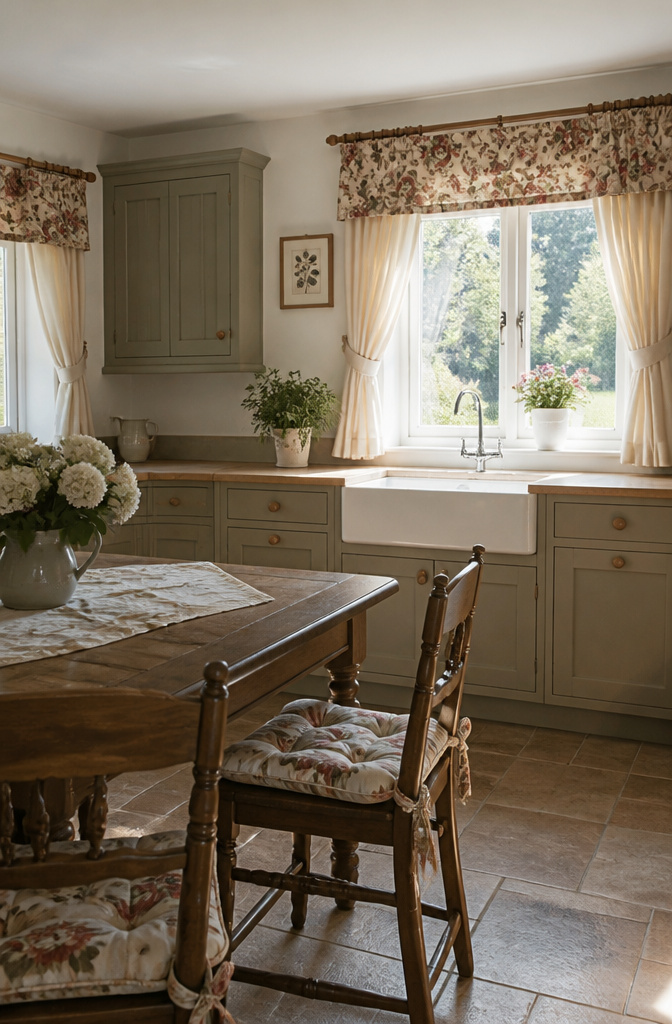
Small repeats read calmer than large ones in a kitchen, where the eye already has plenty to sort through. A tight floral on a curtain or chair cushion adds softness without shouting, while a blowsy cabbage rose at scale can feel like wallpaper in a room that needed breathing room.
Curtains are the safest place to start because they sit at the edges of your vision while you work. Chair cushions come next, since they move and can be rotated out if the pattern tires you. Pottery with painted blooms works on a shelf or windowsill where it catches light but stays out of the traffic pattern.
The fabrics that survive washing are the ones you will actually keep using. A cotton duck or a medium-weight twill holds its color through repeated cycles better than a loose weave that snags on cabinet hardware. Skip anything that says dry-clean only for pieces that will see grease splatter and coffee drips. I look for prints where the background color is forgiving, a deep cream or soft blue that does not show every shadow between washes.
19. Seasonal Decor
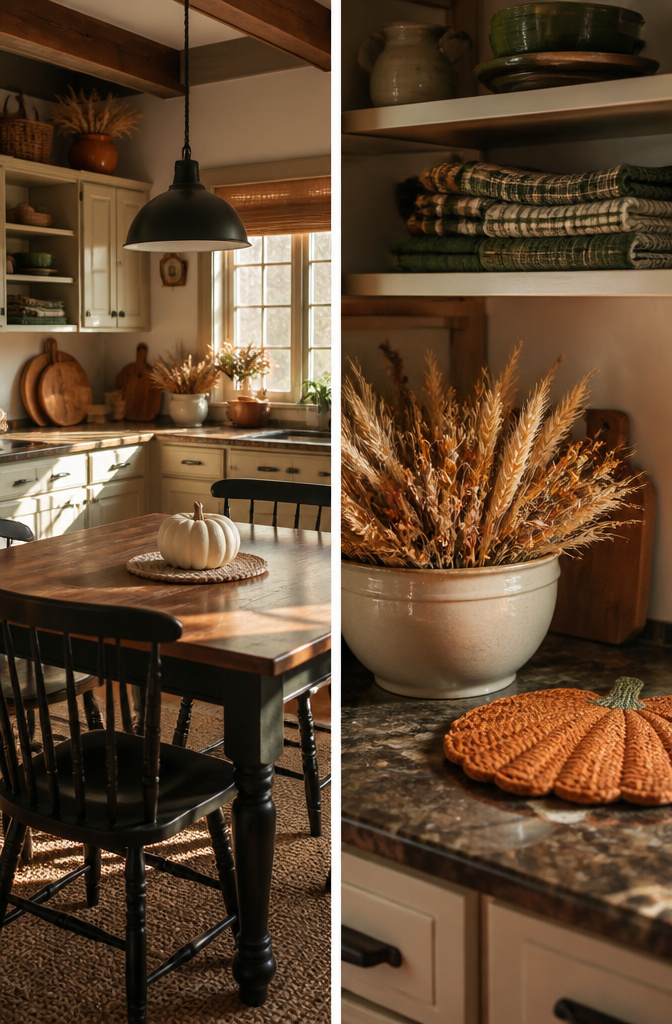
A country kitchen can start to feel like a museum if every surface holds a permanent display. Rotating a small set of seasonal items keeps the room alive without the clutter that eventually makes you avoid whole corners of the house.
I keep a single plastic bin on a closet shelf for the off-season pieces. Summer gingham towels and a ceramic berry bowl live there from October through April, while the fall wheat stems and pumpkin-shaped trivet take their place on the counter for a few months. The swap takes maybe twenty minutes. Three items change: the dish towel set, the centerpiece on the table, and one shelf near the window. Everything else stays put year-round.
This rhythm works because it sets a hard limit. When the November trivet chips, it leaves instead of joining a backup collection. The bin’s size dictates what fits, so the kitchen never accumulates that layer of half-forgotten decor that turns open shelving into a dusting chore.
20. Mixing Modern and Country
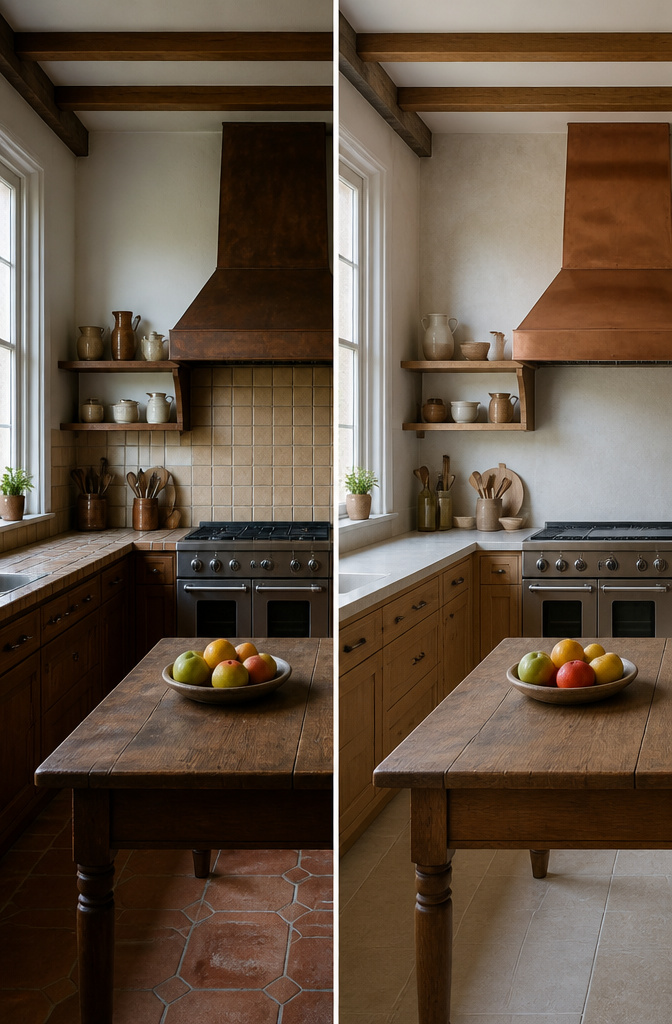
Stainless steel appliances do not cancel out a country kitchen. The trick is pairing them with materials that read rustic, not industrial. An induction range under a copper hood gives you modern cooking speed with the warm, hand-worked finish that signals farmhouse. A paneled dishwasher that disappears into wood cabinets keeps the technology out of sight and the grain of the wood in charge.
The line between eclectic and confused sits at about two competing finishes. Slate or concrete countertops with a corrugated galvanized ceiling works because both materials stay matte and utilitarian. Add glossy cabinets or chrome hardware and the same room starts to feel like two kitchens collided. I have seen the cleanest results when one element, usually the appliances, stays visibly modern while everything else, cabinets, hood, sink, stays in the country vocabulary.
Retro-styled appliances with modern internals, like vintage-look refrigerators, offer another path. They read nostalgic from across the room while still running quiet and efficient. The risk is kitsch: one retro appliance anchors the mix, three look like a diner.
Frequently Asked Questions
What are common mistakes in farmhouse decor?
The biggest mistake is leaning too hard on an all-white palette, which turns airy into sterile fast. Another is buying too many matching vintage reproductions at once instead of letting real pieces accumulate gradually. Literal farmhouse signs and theme-heavy decor also age badly, especially in homes that were never actual farmhouses.
What colors are best for a country kitchen?
Soft whites, creams, beiges, and warm wood tones set the right tone without going blank or cold. Sage green or muted blue work as accents against those neutrals, not as wall-to-wall centerpieces. The warmth comes from layering, not from a single dominant hue.
What defines a country kitchen?
A country kitchen is warm, simple, and genuinely lived-in, built from natural materials like wood and stone plus vintage or rustic accessories that show real use. Exposed beams, open shelving, and distressed finishes signal age and function over showroom polish. The defining quality is that you want to stand in it at six in the morning, not just photograph it for a catalog.