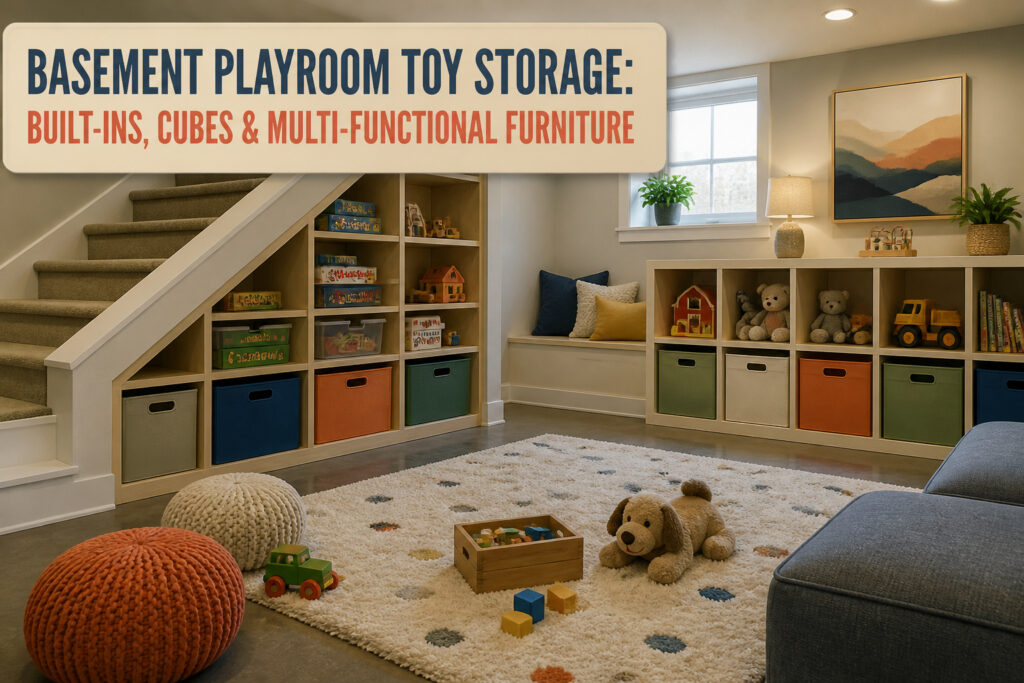
Basement playroom toy storage works only when the system matches the ceiling height and concrete floor you are stuck with. Built-ins turn the dead space inside framed walls and under stairs into bins of Lincoln Logs and dress-up clothes without stealing floor area, which matters where headroom already feels tight. A DIY wall-cavity shelf runs about $60 in plywood and hardware, the same cost one couple logged for a unit that held Melissa & Doug bins.
Built-In Toy Storage
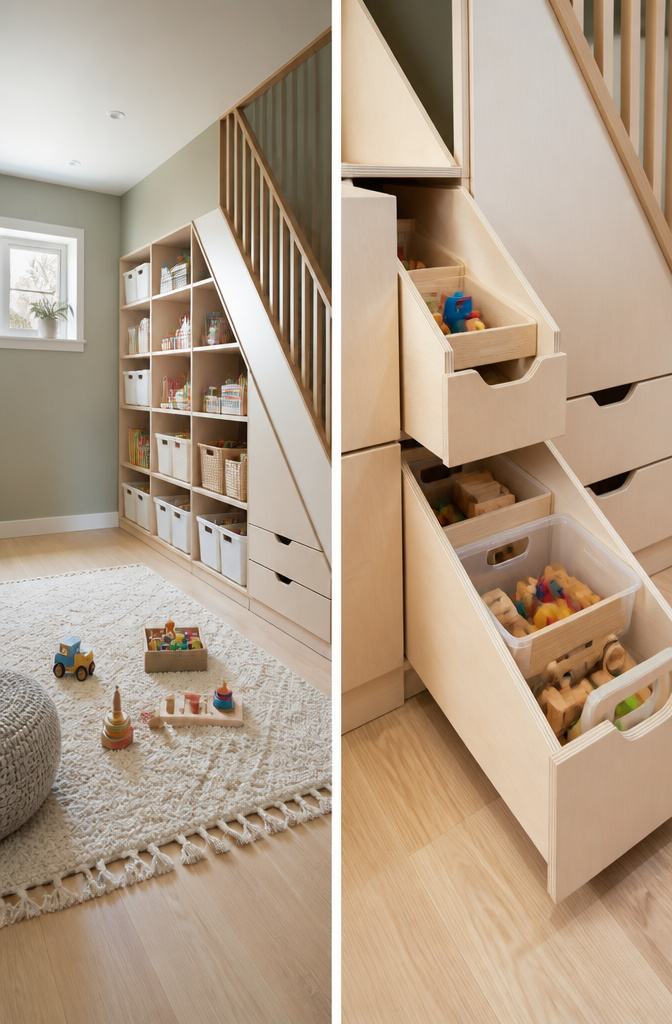
The basement’s framed walls and staircases are dead space until you turn them into storage. A DIY shelf built into a wall cavity can run about $60 in materials, the same cost one couple logged for a sturdy plywood unit that held bins of Melissa & Doug toys and Lincoln Logs. Window-seat benches with lift tops work the same way: the cavity exists, you just add a hinge and a cushion. Under-stair drawers or a playhouse nook with toy bins inside take that awkward angled footprint and make it the main event. Nobody I found published cut lists for these, which means measuring your own studs and slope angles is non-negotiable. The payoff is storage that does not stick out into the room, which matters in a basement where ceiling height already feels tight.
Cube Organizers and Bins
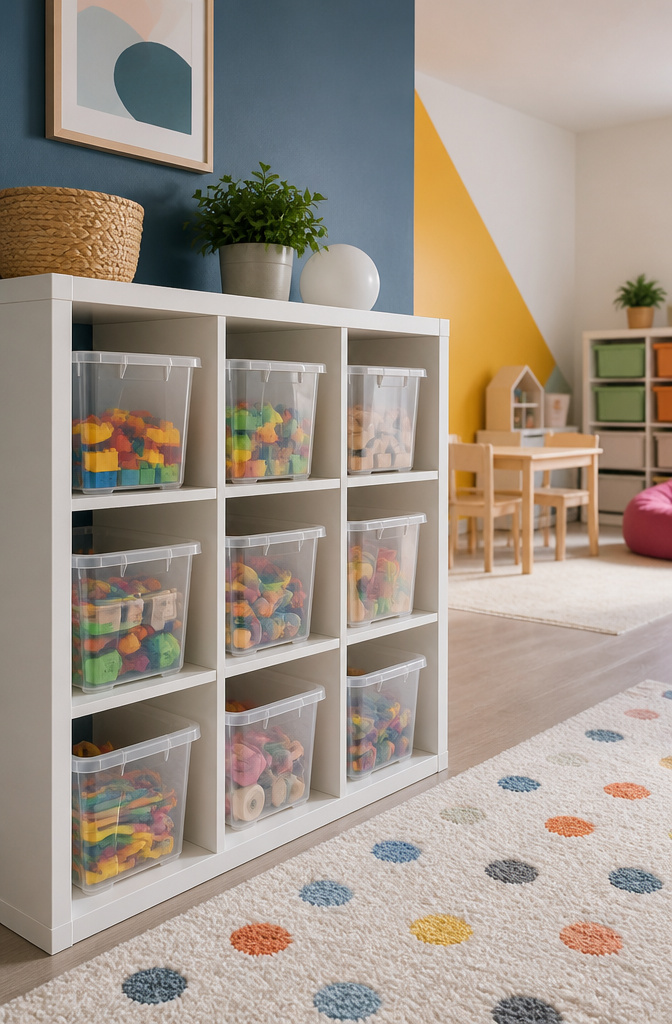
The $59 IKEA KALLAX cube organizer and $6.99 Sterilite bins are the pair that actually gets used, because a kid who can’t see their toys won’t go looking for them. Clear or open-front bins let them scan the contents in one glance, and the 13-inch cube depth is shallow enough that nothing gets buried past arm’s reach.
I hung one KALLAX unit with its top surface at 20 inches from the floor, which lands right at preschooler elbow height. That shelf becomes a coloring station or Lego surface without buying a separate kids’ table, and the cubes underneath still hold eight bins of blocks, dress-up, or art supplies. The 20-inch height matters: much lower and an older kid is hunching, much higher and the little ones are climbing.
The Sterilite bins slide out without fighting the frame, which means cleanup stays a one-handed job even when a child is already half-distracted by the next thing they want to play with.
Multi-Functional Furniture
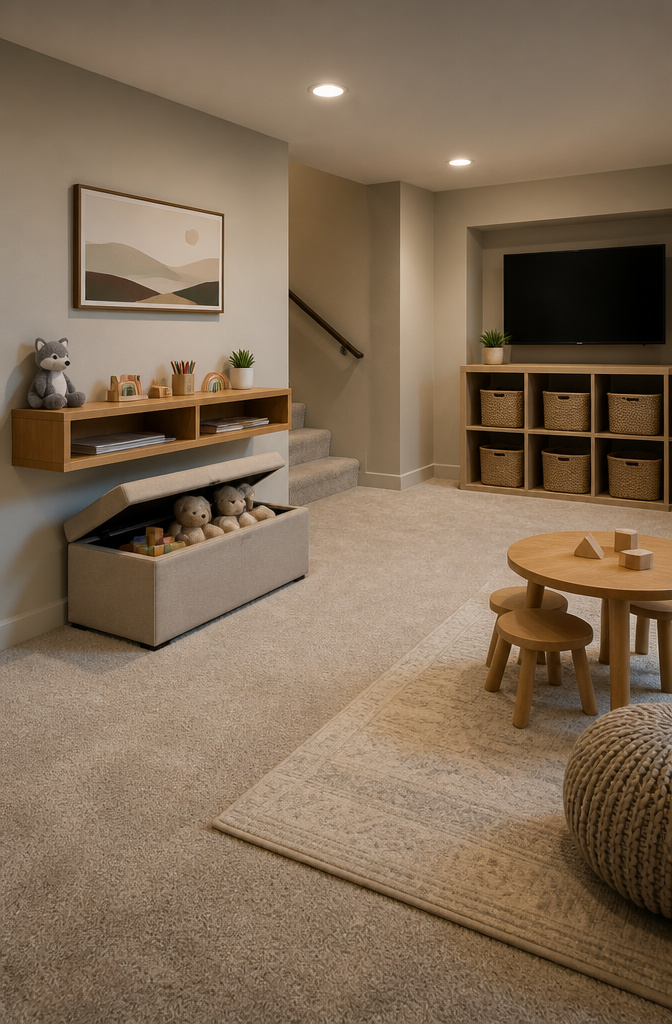
A basement playroom fights for every inch of floor space, so the furniture sitting there has to work harder than it would upstairs. I learned this after watching a too-big activity table turn a walkway into an obstacle course. The fix was a 20-inch wall-mounted shelf hung at kid height with utility brackets anchored to studs, which gave the same coloring surface without stealing square footage from the room below it.
Ottomans that open up and futons with storage drawers underneath earn their keep the same way. The ottoman swallows stuffed animals or building sets in the gap between play sessions, and a futon drawer holds board games or dress-up clothes that would otherwise spill into the open floor. These pieces replace the single-purpose furniture that tends to colonize basement space: the standalone toy chest, the narrow side table that holds nothing but a lamp.
The 9-cube organizer from Target sits in our setup as a TV stand now, not a wall-hugging afterthought. That move opened up the side wall for actual play and proved that storage can hold two jobs if you place it deliberately. In a basement, where windows are scarce and the walls can feel close, that kind of double duty matters more than it would in a sunlit room upstairs.
Play Zones for Different Activities
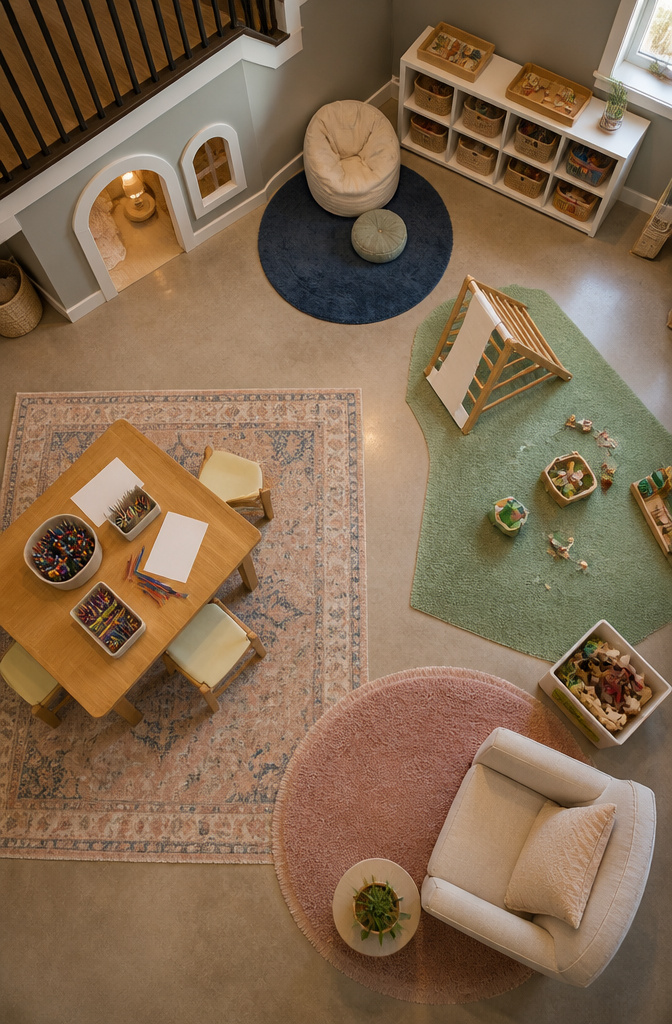
Dividing the basement into craft, reading, and active play zones keeps toys from drifting into one undifferentiated pile. The reading corner in our space got its definition from a single accent wall of wallpaper behind a wide chair that fits two during storytime. That visual boundary alone trains kids to leave the Legos elsewhere.
Each zone collects its own storage type almost automatically. The craft table gathers marker bins and paper trays within arm’s reach. The open floor for active play stays open because the balls and ride-ons live in a bin wall at the perimeter, not in the middle where they become obstacles.
The under-stair playhouse anchors the pretend-play zone. House numbers, a window box, and a miniature door make the space feel designated rather than leftover, and a few bins tucked inside give the kitchen set and dress-up clothes a home that is out of the main traffic line. When every zone carries its own load, cleanup becomes sorting by location instead of hunting through a single toy monsoon.
Decorative Storage Options
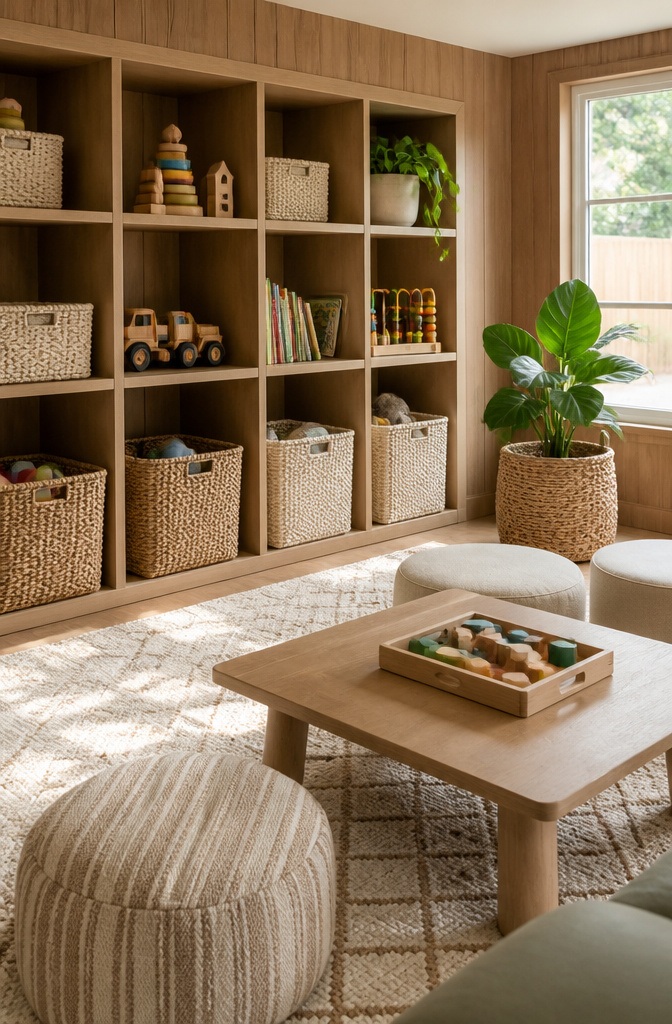
Woven baskets and hampers soften the hard edges of a basement playroom without adding another piece of furniture to dust around. The $24 woven basket from a discount store like Marshalls reads as decor on a low shelf while swallowing the single stuffed animal, the dress-up cape, the half-built Lego set that never seems to make it back to its bin. Kids can reach in and out without lids to fight, so the put-away actually happens.
A hamper does the same job with more volume. Balls, blocks, the random clutter that accumulates by 10 a.m. on a Saturday, all drop in and the room looks sorted in about thirty seconds. The trick is placement: keep these within kid reach, not tucked behind the couch where only you can get to them. If they have to ask for help to clean up, they will not clean up.
I like mixing a few of these in with whatever shelving system is already there rather than building the whole room around matching bins. The baskets move when the play shifts from dolls to art supplies, and when company comes downstairs you are not staring at primary-colored plastic.
Safety Features
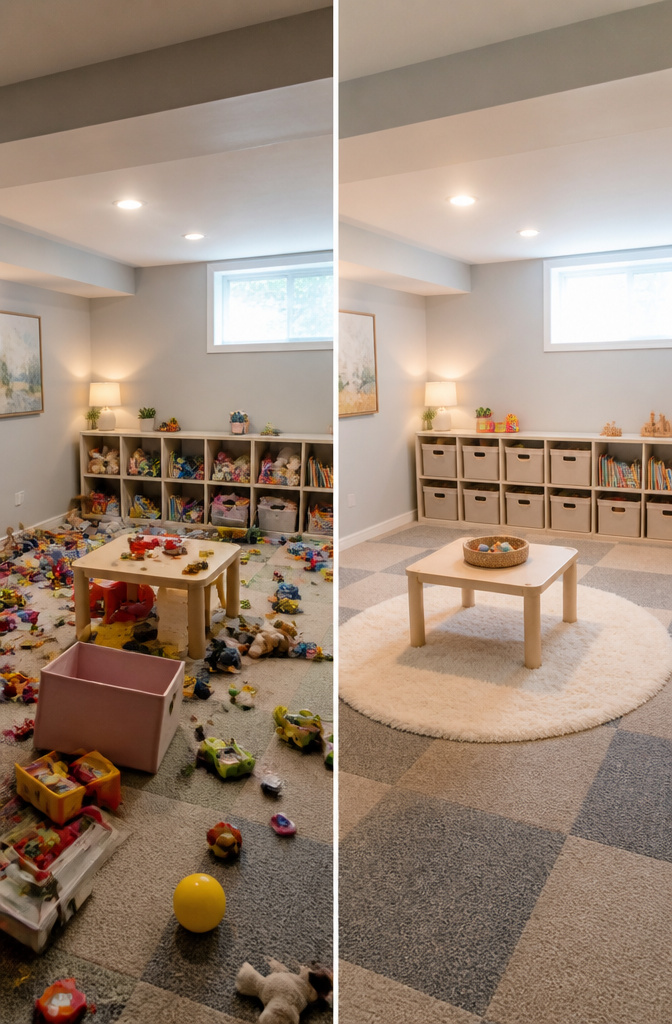
Walk through the basement at a child’s height and the hazards you missed standing up jump out fast. Sharp corners on low tables, loose cords trailing from a lamp, outlets at perfect toddler level. I anchor anything over thirty pounds to the wall with straps, not because the kids climb everything but because they climb the one thing I assumed they wouldn’t. Outlet covers go on every socket, even the half-hidden one behind the storage unit.
Carpet tiles are the flooring I keep coming back to for this space. One juice box disaster means replacing a single square, not scrubbing a broadloom stain or living with it. Foam mats work for the infant-to-preschool years, and cork holds up warmer than concrete if you want something that looks less daycare.
The indoor swing my neighbor installed became the feature every visiting kid remembers. She bolted it through a ceiling joist, not just drywall, and used a swivel hanger rated for several times her first-grader’s weight. Basement ceilings are lower, so the arc stays small and the landing zone needs padding underneath. A small rug beneath it, like the Studio DB setup, marks the space without cluttering the room.
Lighting a Basement Playroom
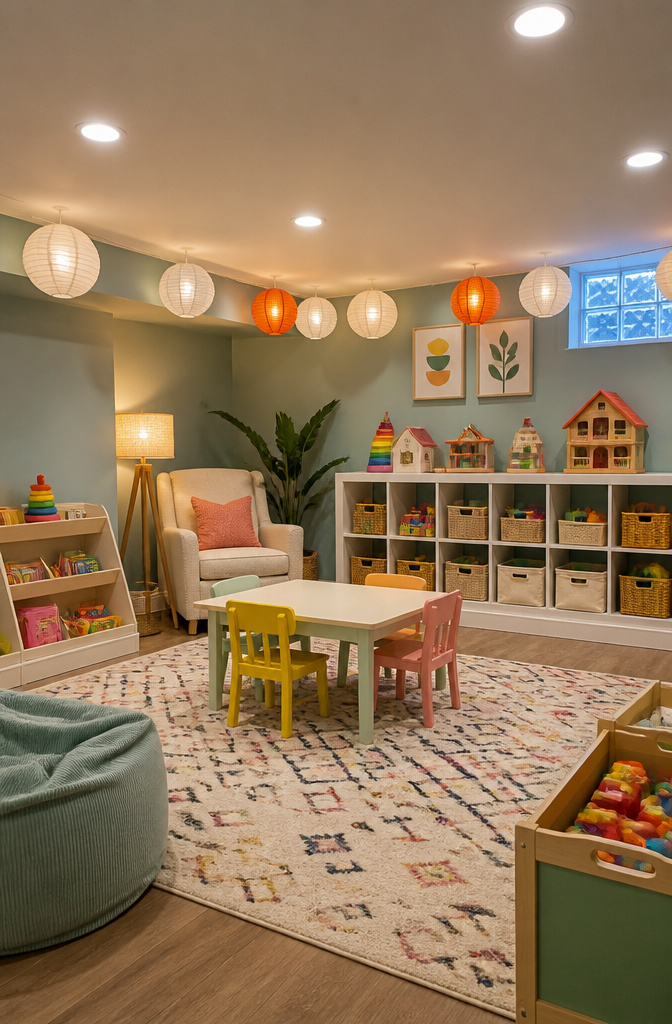
Basement lighting needs to work harder than any other room in the house. Without a plan, the space stays dim even with fixtures on, and a dim basement playroom becomes storage with toys in it instead of a room kids want to use.
Start with bright overhead lighting for the whole floor area. Recessed cans or a flush mount on a higher lumen rating keeps the running path safe and the building blocks visible. Then build downward: a small lamp near any reading chair, something extra above a craft surface. The layers matter more than the wattage on any single fixture.
Where no window exists, the bulb choice does the pretending. A daylight-balanced LED in the right overhead spot reads closer to morning than the cold white that makes basement walls look gray. Paper lanterns strung along a low ceiling soften the beam and bounce it around corners that a single fixture would miss.
"Basement playrooms feel cooler than some family rooms. They’re creatively designed and multifunctional. Think mini-game zone that’s equal parts whimsical fort and efficient storage area."
— Hunker
That multifunctional idea only holds if the lighting supports each function. A reading corner with fun wallpaper and a spacious accent chair still fails when the lamp is too weak to see the pages. The room gets used when the light makes it feel like a room first and a basement second.
Flooring That Survives Play
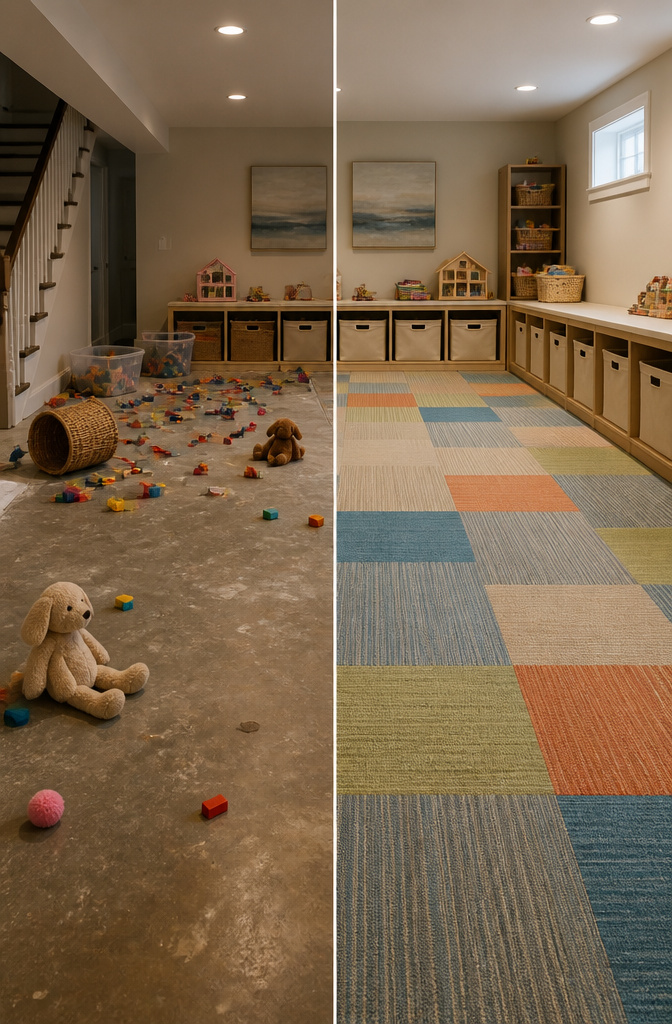
Concrete basement floors sit cold and hard against small knees, so the flooring layer matters as much as whatever bins you slide underneath. I looked at three routes that actually hold up down there.
Carpet tiles win for the long haul because one stained square lifts out and swaps in fresh, no installer needed. Foam mats make sense for toddlers still toppling, though a punctured juice box seeps straight through the seams into whatever sits below. Wall-to-wall carpet in a basement is a sponge for every spilled drink and the humidity that rises through concrete; once mold sets in, the whole roll goes. Cork runs warmer than bare slab and keeps its shape, but it still needs a moisture barrier underneath. Slick vinyl or polished concrete looks clean until a four-year-old rounds a corner in socks. The grip matters more than the color.
What I Built Under the Stairs
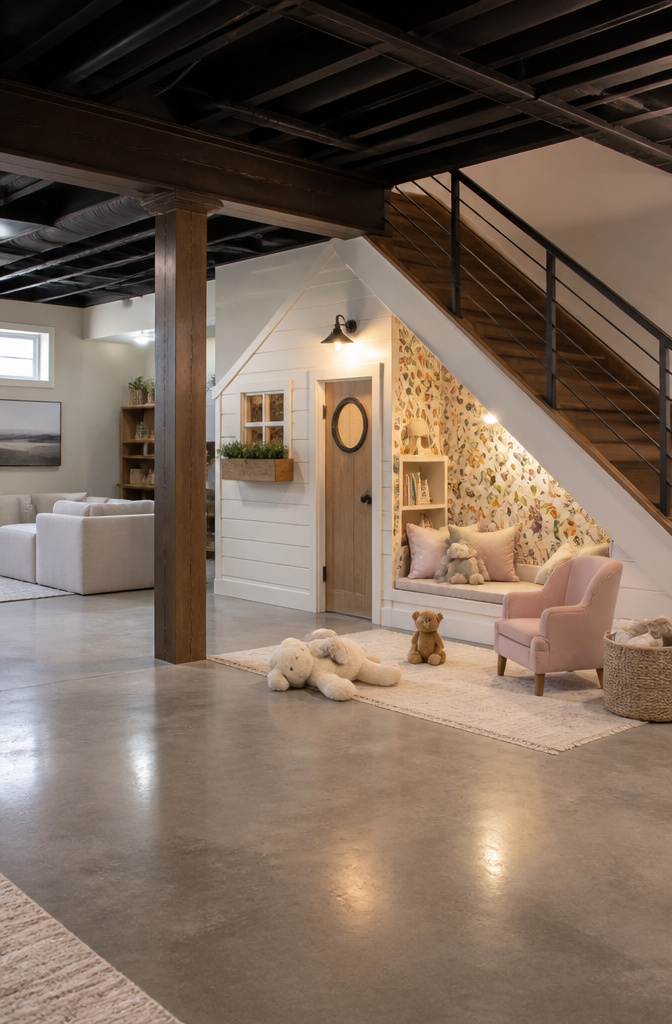
The triangle under a basement staircase is dead space until you decide who gets to use it. For us, that meant splitting it into two zones: a reading corner at the wide end where the ceiling still clears five feet, and a playhouse tucked into the narrow end where only the kids can stand upright.
The reading corner needs real seating, not a throw pillow on the floor. A single accent chair wide enough for an adult and two small kids during storytime anchors the space. Wallpaper behind it, something with enough pattern to hide scuffs, turns the concrete backdrop into a room that feels finished.
The playhouse end is where the architecture forces the design. The ceiling drops fast as the stairs descend, so anyone over four feet tall is ducking. That constraint becomes the feature: a miniature door, house numbers, a small window box. Inside, two tiny rooms fit a play kitchen and a few bins for loose toys. The storage stays hidden behind the fantasy, which means the toys actually get put away instead of left in the open.
What surprised me, reading through the projects that pulled this off, was how the two zones together, quiet and pretend, let one awkward footprint serve both needs without either feeling like an afterthought.
Storage Types Compared
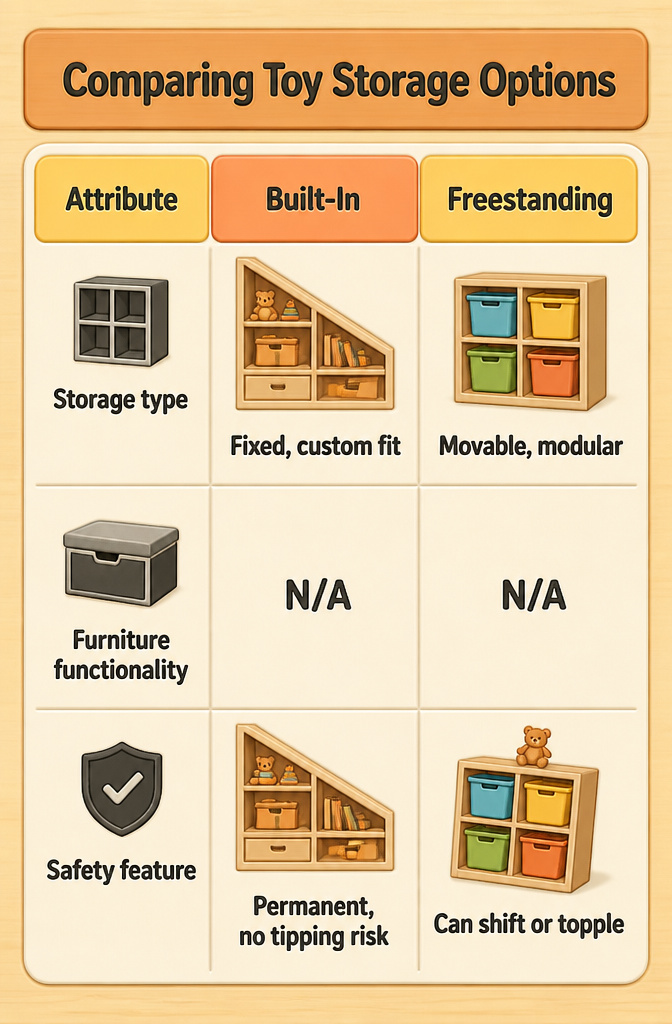
Built-in shelving stays put and swallows awkward angles under stairs or along low foundation walls, but freestanding units let you pull everything out when the water heater leaks or you need to reconfigure the room in an afternoon. Multi-use pieces, benches with bins or ottomans with lids, cost more upfront than a basic cube rack yet replace separate seating and storage. Single-purpose furniture dedicates every inch to toys and tends to run cheaper per cubic foot of storage.
Anchoring matters on concrete, where a six-foot unit can skate across epoxy paint if a kid climbs it. L-brackets into wall studs or adhesive seismic straps handle that. Soft flooring, interlocking foam or low-pile carpet tiles, cushions falls but does nothing to stop tipping. The two approaches stack: anchored built-ins plus a forgiving floor surface cover most basement playroom toy storage risks without turning the space into a padded cell.
| Attribute | Built-In | Freestanding | Multi-Use Furniture | Single-Purpose | Anchored | Soft Flooring |
|---|---|---|---|---|---|---|
| Storage type | Fixed, custom fit | Movable, modular | Hidden compartments | Open bins/shelves | Secured to wall | N/A |
| Furniture functionality | N/A | N/A | Seating + storage | Storage only | N/A | N/A |
| Safety feature | Permanent, no tipping risk | Can shift or topple | Weighted base often included | Requires separate anchoring | Prevents climbing accidents | Impact absorption |
Frequently Asked Questions
What are some good storage solutions for a basement playroom?
Built-in shelving turns wall cavities and under-stair angles into fixed storage for about $60 in materials, and a DIY plywood unit can hold bins for toys like Lincoln Logs and Melissa & Doug sets. Cube organizers such as the IKEA KALLAX at $59 paired with $6.99 Sterilite bins keep toys visible and within arm’s reach. Woven baskets at around $24 soften the room’s look while swallowing loose items, and multi-functional pieces like storage ottomans or futons with drawers replace single-purpose furniture that eats floor space.
How can I make a basement playroom safe for kids?
Anchor anything over thirty pounds to the wall with straps or L-brackets into studs, since kids climb the one piece you assume they won’t. Cover every outlet, including half-hidden sockets behind storage units. Choose carpet tiles or interlocking foam for the floor so falls hurt less and spills lift out rather than soak in, and avoid slick vinyl or polished concrete where socks become skates.
What type of flooring is best for a basement playroom?
Carpet tiles win for longevity because one juice-stained square lifts out and swaps fresh without an installer. Foam mats work for toddlers still tumbling, though liquid seeps through seams. Cork runs warmer than bare concrete and keeps its shape but needs a moisture barrier underneath. Skip wall-to-wall carpet, which acts as a sponge for spills and basement humidity, and avoid slick surfaces where fast-moving kids in socks lose grip.
How can I create different activity zones in a basement playroom?
Divide the space into craft, reading, and active play areas so toys sort by location instead of drifting into one pile. A reading corner gets defined by an accent wall of wallpaper behind a wide chair that fits two during storytime. The craft table gathers marker bins and paper trays within arm’s reach, while active play stays open because balls and ride-ons live in perimeter bins, not mid-floor obstacles. An under-stair playhouse with a miniature door and window box anchors pretend play, with toy bins tucked inside and out of traffic.